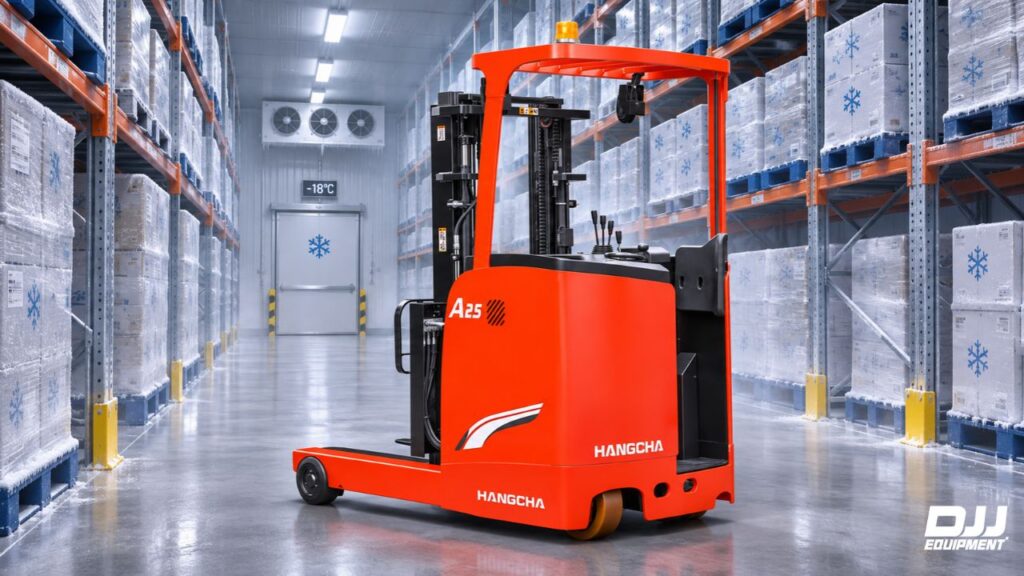
Electric forklifts built as cold store versions work in cold storage and freezers. Hangcha builds F2 cold store versions of its A Series reach trucks and its X and XA Series pallet trucks and pallet stackers, rated down to -30°C, and offers a cold storage option on several XC and XE Series counterbalance forklifts. A standard electric forklift isn't built for a freezer, because the cold thickens hydraulic oil, stiffens seals and drains the battery. LPG and diesel forklifts belong outside a closed cold room, where their exhaust has nowhere to go.
Most cold stores run more than one machine. Battery-electric forklifts take the dock and the heavier loads, reach trucks work the freezer racking, and electric pallet trucks move pallets through the cold room door.
Which forklift types come in a cold store version?
These are the Hangcha machine types DJJ Equipment sells with a cold store version, with the lowest temperature each one is built for.
| Machine type | Hangcha models with a cold store version | Capacity | Built for temperatures down to | Where it works in a cold store |
|---|---|---|---|---|
| Reach truck | A Series reach truck 1.2-2 t, 1.5-1.8 t and 2-2.5 t (F2 models) | 1.2-2.5 t | -30°C | Freezer racking, up to 12.5 m on the 1.2-2 t series |
| Electric pallet truck | X Series and XA Series pallet trucks 2-3 t (F2 models), A Series walkie pallet truck 2 t | 2-3 t | -30°C | Runs between the dock and the freezer, loading refrigerated trucks |
| Pallet stacker | X Series and XA Series pallet stackers 1.2-2 t (F2 models) | 1.2-2 t | -30°C | Low racking and short runs, stacking up to 6 m on the XA Series |
| 4-wheel electric counterbalance forklift | XC Series PMSM 1.5-3.8 t, XC Series 6-10 t, XE Series 4-5 t | 1.5-10 t | -30°C, or -18°C or -30°C on the XE Series 4-5 t | Dock work, block stacking and heavy loads |
A cold store forklift is a version of a standard model, built for the cold, rather than a separate machine. On the A Series reach truck 1.2-2 t, the F2 versions share the capacity, reach and aisle figures of the standard trucks, so you pick the truck on load and height first and then order the cold store build. A cold store version is also an option on the A Series man-down turret truck 1-1.5 t and the XH Series 4-5 t electric forklift.
Why a standard electric forklift struggles in a freezer
A standard electric forklift struggles in a freezer because its oil, seals, battery and electronics are made for normal indoor temperatures. Hydraulic oil thickens as it cools, so the mast lifts more slowly and the pump draws more current. Rubber seals and hoses stiffen and start to weep. The battery delivers less of its charge, and the cold slows charging as well.
Cold store builds change those parts. On the XC Series 4-wheel electric forklift 1.8-3.1 t, the battery pack that rolls out from the side has low-temperature electric heating, and on the XH Series 4-5 t the motors, controllers and high-voltage parts are sealed to IP67. Being electric doesn't make a forklift cold-store rated on its own. The cold rating comes from the build, so ask for it by name when you order.
Can you use an LPG or diesel forklift in a cold room?
An LPG or diesel forklift is the wrong choice inside a closed cold room or freezer. Cold rooms are sealed to hold the cold, so carbon monoxide from the exhaust builds up instead of clearing. SafeWork NSW names poor ventilation in cool rooms and freezers, and the build-up of fumes from forklifts, as a hazard of working in the cold.
Safe Work Australia's forklift guide puts cold stores on its list of poorly ventilated areas where a forklift that produces no emissions is the right pick. If an engine truck has to go in, the guide calls for regular engine tuning and air monitoring. The limit is also getting tighter: from 1 December 2026, the Australian workplace exposure limit for carbon monoxide drops from 30 ppm to 20 ppm, averaged over an 8-hour day.
Engine trucks still have a place on the site. The rules on using a diesel forklift indoors don't limit the open yard, so an LPG or diesel truck can unload containers outside and hand the pallets to an electric truck at the cold room door.
Which battery suits a cold storage forklift?
A lithium battery with built-in heating suits most cold storage forklifts, because it holds its charge better in the cold and doesn't need a charging room. The X Series pallet truck 2-3 t, for example, runs a 48V/105Ah LiFePO4 battery with a 6-year or 12,000-hour battery warranty, and the XE Series 4-5 t has battery heating for cold weather.
Lithium cells shouldn't be charged while they're very cold, which is why cold store packs carry their own heaters. Charge the truck where the battery management system can warm the pack first, and keep the charger out of the freezer unless the manufacturer rates it for the cold.
Lead-acid still works in a cold store, but it needs more planning. Safe Work Australia says lead-acid charging gives off hydrogen gas, so the charging area must be ventilated, and that means charging outside the freezer. The A Series reach truck 1.2-2 t comes with a 48V lead-acid battery as standard, and the 1.6 to 2 tonne models can take an 80V/302Ah lithium battery instead. For trucks working two shifts in the cold, the trade-offs of lithium vs lead-acid forklift batteries lean further towards lithium, because a lithium truck can top up at breaks.
How condensation damages forklifts between the freezer and the dock
A forklift that moves between a freezer and a warmer dock collects condensation every trip. Warm, damp air meets the cold metal and water forms on the electrics, connectors and mast. When the truck goes back into the freezer, that water turns to ice inside switches, plugs and bearings.
The same water ends up on the floor. SafeWork NSW lists slips from ice, water and condensation caused by temperature changes as a cold store hazard, and Safe Work Australia's guide tells operators to slow down on wet surfaces. Tyres matter here: the X Series 3-wheel electric forklift 0.6-1 t has patterned front tyres that resist slipping on wet, sandy or cold store floors.
The simplest fix is to keep freezer trucks in the freezer. Use one truck for the dock and another for the cold room, and hand pallets over at the door. When a cold truck has to come out for charging or servicing, let it dry out away from the doorway before it goes back in. Safe Work Australia says forklifts should be serviced regularly or at least once every 12 months, and a truck that crosses the freezer door all day needs its seals and connectors checked more often than that.
Should a freezer use reach trucks or counterbalance forklifts?
A freezer with racking should use reach trucks for the storage aisles, and keep counterbalance forklifts for the dock and heavy loads. Every square metre of a freezer costs money to keep cold, so narrower aisles put more pallets into the same cooled space. The A Series reach truck 1.5-1.8 t works in aisles from 2,666 mm with 1000 x 1200 mm pallets placed crossways, and the 1.2-2 t series lifts up to 12.5 m.
Counterbalance forklifts need wider aisles, but they handle heavier loads and uneven work at the dock. Warehouse reach trucks are built for smooth, level indoor floors, so they suit the racking and not a ramp or a yard. Licensing differs too: a reach truck is a forklift truck and needs an LF high risk work licence, while pallet trucks and walkie stackers need training but no licence.
Example: 1,000 kg pallets at 7 m in a -25°C freezer
Say you store 1,000 kg pallets of frozen product on the top level of 7 m racking, in a freezer held at -25°C, and your trucks run a sideshifter. All these figures are at a 500 mm load centre. The A Series reach truck 1.5-1.8 t holds 1,050 kg at 7 m, but the sideshifter takes 200 kg off, leaving 850 kg. That's too little.
The 2 t model holds 1,100 kg at 7 m, which drops to 900 kg with the sideshifter, still short. The Hangcha A Series reach truck 2-2.5 t in its 2.5 t model holds 1,300 kg at 7 m, or 1,100 kg with the sideshifter, so it carries the pallet. Ordered as an F2 model, it's built for -30°C, below your -25°C room, and it needs a 2,865 mm aisle for 1000 x 1200 mm pallets placed crossways.
What does a forklift operator need in a freezer?
A forklift operator in a freezer needs protection from the cold, because a cold operator rushes the job to get out. The Safe Work Australia code on the work environment lists cab heaters for forklifts used in cold stores as one way to control cold, and it names hypothermia as the risk of long exposure.
The room needs controls as well. SafeWork NSW says cool room and freezer doors must prevent people being trapped inside, and it lists job rotation, rest breaks and a buddy system among the controls for cold work. Shift length also shapes the choice between a stand-on vs sit-down reach truck, since a stand-on truck suits short trips in and out and a seated truck suits long spells in the racking.
The coldest room a truck enters, and how many times a shift it crosses the door, decide the build it needs. Send DJJ the room temperature, how long each truck stays inside, your heaviest pallet and top racking height, your shifts and where you plan to charge, and we'll match a cold store version to the job. Call sales on 1800 355 388.