Forklift forks must come out of service when the heel has lost more than 10% of the thickness of the upright shank, or as soon as a crack or bend is found. Lift chains are replaced once they have stretched more than 3% past their original length, and every chain on the mast is replaced at the same time. Both limits are measured with gauges, because 10% of a 40 mm fork is only 4 mm of steel.
When do forklift forks need replacing?
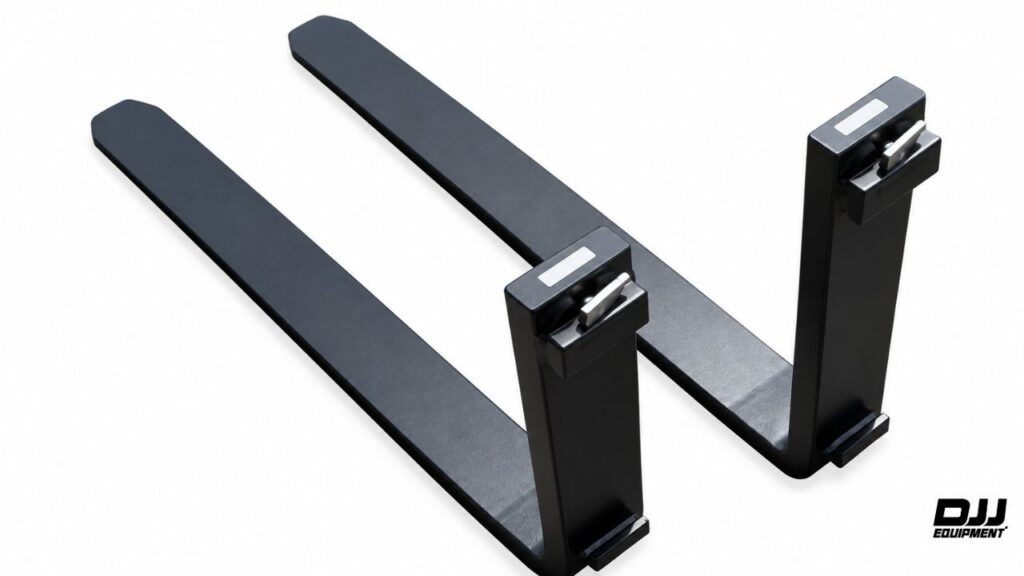
A forklift fork needs replacing when its heel is more than 10% thinner than its vertical shank, or when it has any crack or bend. SafeWork NSW sets out the measurement: take the vertical thickness of the shank, then the horizontal thickness at the heel. If the heel has lost more than 10%, the fork must be replaced.
The heel wears because it scrapes the floor, and the SafeWork NSW forklift safety fact sheet says not to drag it. That wear lands in the worst place. The heel is the corner where the fork turns upward, so it carries the highest bending load on the arm.
A steel section resists bending in proportion to the square of its thickness. A heel worn to 90% of its thickness keeps about 81% of its strength (0.9 x 0.9). So 10% wear costs the fork nearly a fifth of its strength, while it still looks almost new.
On counterbalance forklifts, the fork section grows with capacity. These are the replacement points for the forks on the X Series 4-wheel electric range from DJJ Equipment, with capacities rated at a 500 mm load centre:
| Model | Rated capacity | Fork section (thickness x width x length) | Replace when the heel is thinner than |
|---|---|---|---|
| CPD15 | 1,500 kg | 35 x 100 x 920 mm | 31.5 mm |
| CPD25 | 2,500 kg | 40 x 122 x 1,070 mm | 36 mm |
| CPD30 | 3,000 kg | 45 x 122 x 1,070 mm | 40.5 mm |
| CPD35 | 3,500 kg | 50 x 122 x 1,070 mm | 45 mm |
The margin is 3.5 to 5 mm of steel on an X Series 4-wheel electric forklift. A fork caliper set against the fork's own shank shows it at a glance, while a tape measure won't. The shank is the reference because it doesn't touch the floor, so it keeps its original thickness.
What other fork damage takes a forklift out of service?
Any crack in a fork takes the forklift out of service, and so does a bent blade or shank, a fork tip sitting lower than the other, or a fork positioner that won't lock. None of these can wait for the next service.
Cracks start where the load concentrates: at the heel and at the welded hooks that hang the fork on the carriage. Hangcha's manual for its XH lithium forklifts lists the weld at the root of the fork hook as a periodic check for cracks and wear. A crack in either place can let the fork fail suddenly under a load.
A bent fork, or one whose tip sits lower than its partner, puts more of the load on one arm. Overloads, rack strikes and using the forks as a lever are the usual causes. A technician measures blade straightness, tip height and the heel angle against the fork maker's limits.
The fork positioner has to lock into its slot on the carriage. The XH manual warns that a fork that isn't locked can shift while the truck is driving, and the load can fall.
Worn or cracked forks aren't welded up or heated and straightened in a workshop. Fork steel is heat treated for strength, and welding or heating changes that treatment around the repair. SafeWork NSW also says not to modify forks or tow with them. A worn fork is replaced, not built back up.
When do forklift lift chains need replacing?
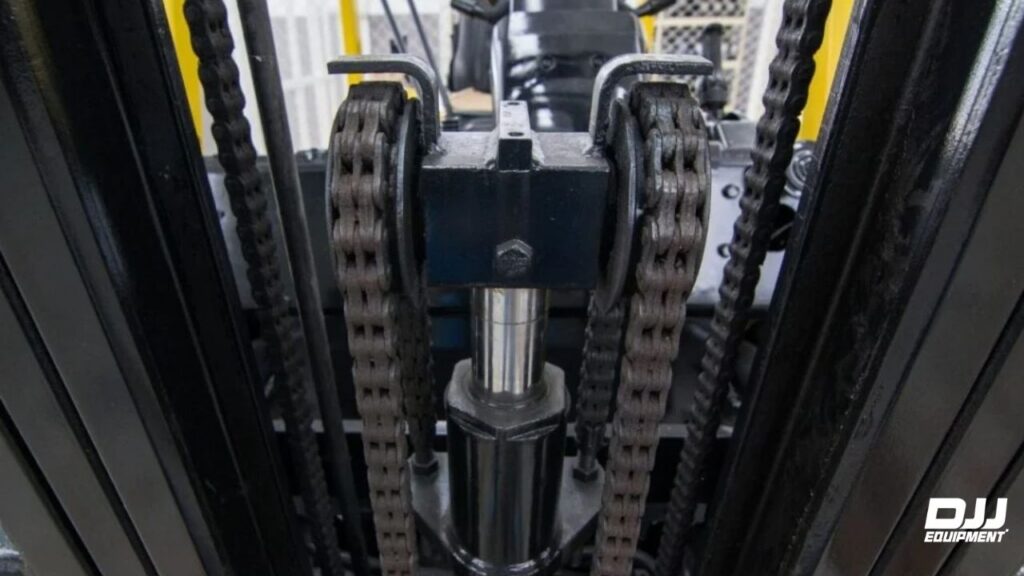
A forklift lift chain needs replacing once it has stretched more than 3% of its original length, or once its link plates have worn more than 3%. That's the limit in Hangcha's manual for its XE lithium forklifts, which has the chains measured at the 250-hour service. On every metre of chain, 3% is 30 mm.
The steel itself doesn't get longer. Each time the chain bends over the mast sheave, the pins turn inside the link plates and wear both. Thousands of lifts add a fraction of a millimetre at every joint, and the worn pins and holes leave less metal to carry the load.
Stretch is measured with a chain wear gauge over a set number of links, not with a tape. The section that runs over the sheave bends on every lift, so it wears first and is the one to measure.
Some lift chain faults mean replacement whatever the stretch: a cracked link plate, a pin that has turned or pushed out of the plate, and rust inside the joints. The XH manual has the chains checked for deformation, damage and rust at periodic services, along with loose riveted pins.
Why are forklift lift chains replaced as a set?
Forklift lift chains are replaced as a set because a new chain next to a worn one is shorter. The shorter chain takes more of the load, the carriage sits unevenly and the new chain wears faster. Hangcha's XE manual says to replace all the chains on the same mast at once.
Even tension matters too. The daily check in Hangcha's XH manual compares the left and right chains with the forks raised 10 to 15 cm and the mast vertical. If they differ, a technician evens them up with the adjusting nuts, then locks them.
A worn chain isn't fixed by swapping out its worst links either. The links next to them have done the same number of lifts. When new chains go on, the sheaves get checked too, because a deformed or damaged sheave wears a new chain quickly.
How often should forklift forks and chains be checked?
Forklift forks and chains get a visual check at the start of every day and a measured check at scheduled services. SafeWork NSW says forklift safety checks are done at the start of each day, and maintenance follows the manufacturer's requirements or a competent person, with a log book kept.
The daily check is for things you can see: cracks, bends and heel wear on the forks, and loose, uneven or rusted chains. The operator reports them and the truck stops, while measuring is left to the service. The rest of the daily checks and service levels are in our forklift maintenance checklist.
On Hangcha's XE schedule, chain stretch is measured at 250 hours, which the manual puts at about every 1.5 months. A truck on double shifts gets there in half the time. For cold or corrosive conditions, the XE manual shortens chain lubrication to every 100 hours.
Cold stores, wet yards and corrosive sites wear chains faster than a dry warehouse, so ask your technician to set the checks by your hours and site.
Who should replace forklift forks and chains on a hired or owned forklift?
Fork and chain replacement on a forklift is a technician's job. Measuring wear takes a fork caliper and a chain gauge, new chains have to be fitted and tensioned evenly, and new forks have to match the truck's carriage, section and forklift fork length.
Carriage class goes up with capacity. On the X Series range above, the CPD15 and CPD25 forks hang on an ISO 2328 class 2A carriage, and the CPD30 and CPD35 move up to class 3A. A fork built for one class won't sit correctly on the other.
On a forklift you own, we service and repair all forklift brands. That's on site within 50 km of our Silverwater, Meadowbrook and Bayswater branches, or in the branch workshop. Each branch keeps commonly required forklift parts for the Hangcha forklifts we sell.
On a forklift hired from us, forks and chains are our job. Under our standard hire terms we service and maintain hired machines during business hours, and only our authorised staff may repair or adjust them. Faults must be reported to us straight away, so stop using the truck and call us.
If a fork heel looks thin or one chain sits slacker than the other, send our service team the truck's make, model and hour meter reading, with a photo of the heel or chain. We'll book a measured check of the forks and chains through our forklift servicing and repairs team. Call 1300 646 747.