A forklift service agreement should say in writing what is serviced and how often, and whether breakdown repairs are covered for parts and labour. It should also say how wear items, damage, batteries and call-outs are charged, because those charges sit outside the price per service. Read the scope rather than the plan's name, because one supplier's full maintenance plan can cover less than another's basic plan. Check it against the warranty on the exact model too. The Hangcha XH Series 4-wheel electric forklift 2-3.8 t carries a 24 month or 2,000 hour warranty, for example.
Why a service agreement matters on a forklift you own
Once you own a forklift, keeping it safe is your responsibility. SafeWork NSW's advice on buying a forklift says it must be maintained according to the manufacturer's instructions, and suggests planning for inspection and maintenance before you buy: a maintenance plan with regular inspections, available parts and support, and competent people to do the work.
A written agreement turns that plan into something you can budget for and check. Without one, servicing tends to happen only when something breaks, which is the most expensive time to find a worn chain or a leaking cylinder.
Planned servicing or full maintenance: which forklift agreement suits you?
Which one suits depends mostly on how many hours the forklift works. Suppliers name their plans differently; three broad types are common.
| Type of agreement | Usually includes | Usually charged separately |
|---|---|---|
| Planned servicing | Scheduled services at set hours: inspection, lubrication, oil and filters, adjustments | Repairs and their parts, wear items, damage |
| Full maintenance | Scheduled services plus repairs from normal wear, parts and labour | Damage from misuse or collisions, and, depending on the plan, tyres, forks and chains |
| Pay as you go | Nothing in advance: each service or repair is quoted when it is needed | Every visit, part and call-out |
Planned servicing suits trucks that work light hours, where repairs are rare. Full maintenance moves more of the repair risk to the supplier, which suits forklifts that work long hours or several shifts. Whichever type you choose, ask for the written list of what is in and what is out, how prices can change during the term and how either side can end the agreement.
DJJ Equipment's after-sales program, DJJ Care, covers scheduled maintenance, parts replacement and technical assistance after purchase, so ask what it includes for your model.
What each scheduled forklift service should include
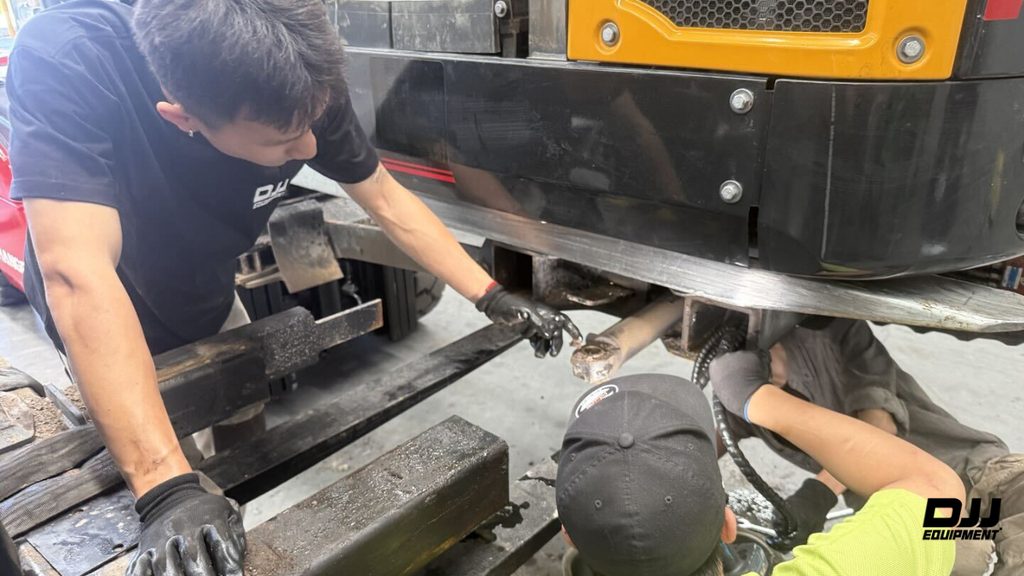
Each scheduled service should follow the manufacturer's checklist and intervals for your model, with more frequent inspections in severe conditions such as freezers, as WorkSafe Queensland advises. Ask for the checklist the technician works through at each visit, not just the price per visit.
Forklift service intervals depend on hours worked, elapsed time and how hard the site is on the truck. The agreement should also cover the attachments and warning devices fitted to the truck, which WorkSafe Queensland says must be maintained and serviced as well. Work on an LPG system has to be done by a licensed gas fitter, and tyres should be fitted by a qualified tyre fitter.
Check who the technicians are. WorkSafe Queensland notes that light and heavy vehicle mechanics are generally not competent to maintain forklifts, so ask for forklift-trained technicians. Daily checks stay with the operator, and a scheduled visit doesn't replace them.
Does the agreement cover forklift breakdowns and call-outs?
Not every forklift service agreement covers breakdowns and call-outs, and the gap shows when a truck stops mid-shift. Confirm whether breakdown repairs are included or quoted separately, whether a call-out fee or travel time is charged, and which hours the service team works.
Response times only count if they are written down. A verbal promise of fast service is no help in a dispute, so ask what the agreement actually commits to and what happens if a repair takes days, for example whether a replacement machine is part of the arrangement.
Parts availability affects how long a repair takes. Ask which parts are held locally and how others are sourced; DJJ keeps commonly needed forklift parts at its Sydney, Brisbane and Perth branches.
Location matters too. DJJ services forklifts on site within 50 km of each branch during business hours, with workshop repairs at each branch, so check that your site sits inside the area any supplier covers.
Who pays for forklift tyres, forks, chains and damage?
Who pays for tyres, forks, chains and damage depends on the agreement, so check it before you sign. Tyres, forks, lift chains, hoses and brake parts wear with use, and an agreement may leave them out or include them only up to a limit. Forks have a hard limit: SafeWork NSW says a fork worn more than 10 percent at the heel must be replaced, not repaired. Damage from a collision, overloading or misuse is normally charged separately.
Ask how the two are told apart, who decides, and whether you get photos or a written report when a repair is put down to damage rather than wear.
Are forklift batteries and chargers in the agreement?
On an electric forklift, check whether the battery and charger are in the standard agreement or sold as a separate item. Confirm who checks the charger, who tops up and cleans a lead-acid battery, and who tests battery condition.
The battery can also carry its own warranty. On the XC Series 4-wheel electric forklift PMSM 1.5-3.8 t it is 6 years or 12,000 hours, so make sure the agreement's battery checks meet the warranty conditions.
Lithium batteries remove the watering job but still need the charger, cables and connectors checked, which is one of the running-cost differences between lithium and lead-acid forklift batteries.
Forklift service records, warranty and resale value
Every visit should leave a record: what was done, what is wearing and what will need attention next time. Keeping those records is not optional. WorkSafe Queensland says to keep records of all maintenance, including servicing, testing and alterations, and SafeWork NSW's forklift safety fact sheet says a log book or maintenance records must be kept.
Ask whether the manufacturer's warranty depends on servicing at set intervals and on keeping those records, so a missed service doesn't put a claim at risk.
Records pay off again when the truck is sold. Service history is one of the factors that sets a forklift's trade-in value, along with its hours and the condition of the battery or engine.
Can one service agreement cover a mixed forklift fleet?
If you run more than one brand, decide whether one supplier will look after the whole fleet or each brand will go back to its own dealer. One supplier means one set of records and one point of contact, but check it can repair every brand you own, not only service it.
DJJ services all forklift brands and repairs Hangcha forklifts; repairs on other brands are assessed case by case, so check your model with the forklift service team.
Do you need a service agreement on a hired forklift?
A hire agreement usually includes servicing already. Under DJJ's standard hire terms, hired machines are serviced and maintained during business hours, 8am to 5pm Monday to Friday, while the hirer does the daily checks, supplies fuel, charges batteries and pays for damage from misuse and for tyres.
Hire suits trucks you need for a season or a fixed project, and forklift hire with maintenance included removes the need for a separate service agreement during the term. Extra hours above the agreed allowance are charged at an overtime rate, so match the allowance to the hours you really work.
Tell the DJJ team the model, its hours, how many shifts it works and where it is based, and ask about scheduled maintenance after purchase or a free fleet assessment. Call the service team on 1300 646 747, or 1800 355 388 for sales and hire.