A walkie stacker suits short indoor runs on smooth floors, while a forklift suits loading trucks, ramps, yards and long runs with heavier pallets. Hangcha's walk-behind X Series stacker is rated at 1.2 to 2 tonnes on a 600 mm load centre and works in a 2,200 mm aisle at 6 km/h laden. A 1.5 t XC Series electric forklift needs a 3,555 mm aisle, but travels at 16 km/h laden and climbs a 20% grade. A walk-behind stacker needs operator training but no forklift licence, while a forklift operator needs an LF high risk work licence.
The table puts two Hangcha stackers next to two Hangcha electric forklifts, all four from the range DJJ Equipment sells.
| Machine | Operator | Licence | Rated capacity (load centre) | Maximum lift | Stacking aisle | Travel speed, laden |
|---|---|---|---|---|---|---|
| X Series pallet stacker CDD14 | Walks behind | Training, no LF | 1,400 kg (600 mm) | 6,000 mm | 2,200 mm | 6 km/h |
| A Series counterbalanced pallet stacker CPDB12 | Rides a fold-down platform | LF | 1,200 kg (500 mm) | 5,500 mm | 2,810 mm | 5.5 km/h |
| XC Series electric forklift CPD15 | Seated | LF | 1,500 kg (500 mm) | Up to 6,000 mm | 3,555 mm | 16 km/h |
| XC Series electric forklift CPD25 | Seated | LF | 2,500 kg (500 mm) | Up to 7,000 mm | 3,734 mm | 18 km/h |
The forklift needs about 1.4 m more aisle than the walk-behind stacker and travels close to three times as fast. The ratings also sit on different load centres. The stackers in the table are rated at 600 mm and 500 mm, the forklifts at 500 mm, and a rating at 600 mm comes out lower than the same truck's rating at 500 mm.
Hangcha measures these aisles with 1000 x 1200 mm pallets carried crossways.
How do a walkie stacker and a forklift keep the load stable?
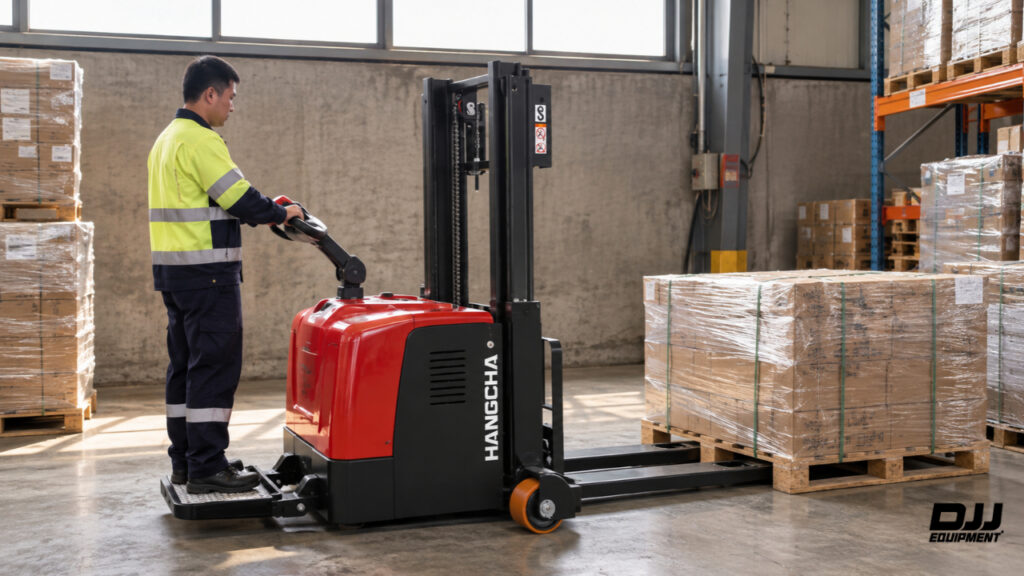
A walkie stacker keeps the load stable with two support legs that run forward under the forks, while a forklift balances it with a heavy counterweight at the back. The legs keep the combined centre of gravity inside the wheelbase, so the stacker doesn't need much weight of its own. A forklift has nothing in front of its front wheels, so the counterweight has to outweigh the load.
You can see it in the service weights. The XA Series forklift CPD25 weighs 3,650 kg with its battery to carry a 2,500 kg rated load. That mass is also what lets a forklift hold more at height.
The XC CPD25 still holds 1,450 kg at 7 m on a 500 mm load centre. The walk-behind X Series pallet stacker CDD14 holds 450 kg at 6 m on a 600 mm load centre. The data plate on each truck is the authority, and attachments cut these figures further.
How much aisle does a forklift need compared with a walkie stacker?
A 1.5-2.5 t electric forklift needs about 3.6-3.7 m of aisle to stack a pallet, against 2.2 m for a walk-behind stacker. The stacking aisle depends mainly on the truck's turning radius, plus the pallet length and a safety clearance.
The walk-behind X Series stacker turns in 1,550 mm. The XC Series electric forklift turns in 1,950 mm on the CPD15 and CPD18 and 2,090 mm on the CPD20 and CPD25, which puts their aisles at 3,555-3,734 mm.
A counterbalanced stacker sits between the two. The A Series CPDB models need 2,760-3,228 mm, because the counterweight makes the body longer than a stacker with legs. Rack protectors and pallet overhang eat into an aisle, so measure at the narrowest point between the racks.
Which pallets and loads suit a walkie stacker or a forklift?
A forklift can pick up almost any pallet or load, while a walkie stacker with legs under its forks is limited by the pallet's bottom boards. The Australian standard pallet is 1165 x 1165 mm, and pool pallets are double-decked. A legs-under-forks stacker can only enter them from the sides where its load wheels clear the bottom boards, so test the machine with your own pallets before you buy.
Trucks raise the same problem. The support legs can't run under a truck tray or a trailer deck, so a walkie stacker can't lift pallets off a truck from the ground. A forklift has no legs in the way, which is why the dock and the yard are forklift work.
The A Series counterbalanced pallet stacker has no legs under the forks, so it takes closed-bottom pallets from any side inside the warehouse. It's still built for indoor floors, with 6% laden gradeability and a 5.5 km/h laden travel speed.
Can a walkie stacker work on ramps and outdoors like a forklift?
No. A walkie stacker is built for smooth, level indoor floors, and a forklift is the machine for ramps, dock plates and yards. Hangcha's XA Series pallet stackers climb 8% laden on the 1.2 t model and 5% on the 1.6 t and 2 t models. The XC Series forklift climbs 20% laden and is rated IPX4 for outdoor work.
Wheels make the other difference. A stacker rolls on small, hard wheels that pass every crack and bump straight into the chassis and mast. Pneumatic tyres are why 4-wheel counterbalance forklifts such as the XA Series work on warehouse floors and in outdoor yards, with 18% laden gradeability on the 2 t and 2.5 t models.
If pallets cross a ramp between the dock and the racking, check its gradient against the laden figure for the machine. A site with a sloping driveway or a gravel yard needs a forklift there, and the stacker should stay on the slab inside.
Is a walkie stacker a forklift under licence rules?
A walk-behind walkie stacker isn't a forklift under licence rules, so the person walking behind it doesn't need an LF licence. Under WorkSafe Queensland's forklift truck definition, a forklift is a powered truck with fork arms that rise 900 mm or more, and a pedestrian-operated truck or a pallet truck is left out. Every counterbalance forklift falls inside that definition, so its operators need an LF licence.
The exemption depends on the operator walking. A stacker the operator rides, such as the stand-on X Series or the A Series counterbalanced stacker with its fold-down platform, lifts well past 900 mm and isn't pedestrian-operated, so it's an LF machine. Check with your state regulator if a machine can be used both ways.
A walkie stacker operator still has to be trained and instructed before using one, and the business still has to manage the risk under WHS law. So whether you need a forklift licence for a walkie stacker has a short answer: no licence, but training before anyone uses it.
Walkie stacker or forklift for long runs and busy shifts?
For long runs and pallets moved all shift, a forklift is faster and easier on the operator. The walk-behind X Series stacker travels at 6 km/h laden, and its travel speed drops once the forks pass 500 mm. The XC Series forklift travels at 16-18 km/h laden with the operator seated.
Walking is the hidden limit. A stacker operator walks every metre the pallet travels, so a long run between the dock and the racking tires people well before it flattens the battery.
The stand-on X Series lifts the speed to 8-9 km/h laden on a shock-absorbing platform. Its operator then needs the same LF licence as a forklift driver, so the licence saving disappears.
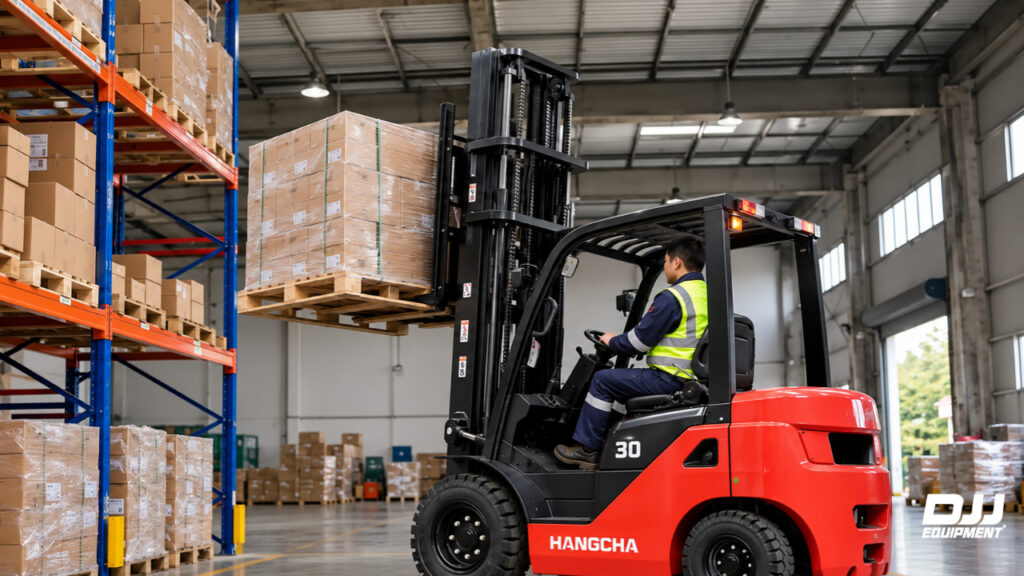
What do a walkie stacker and a forklift cost to buy and run?
A walkie stacker costs considerably less to buy than a counterbalance forklift, and its smaller battery needs a smaller charger. The X Series stacker runs on a 48V lithium battery. The XC Series forklift uses 80V lithium batteries from 202Ah to 404Ah, so plan the charging point and power supply before it arrives.
Warranty terms differ by model. The X Series pallet stacker carries 12 months / 2,000 hours on the truck, and its lithium battery carries 6 years or 12,000 hours. The XC and XA Series forklifts carry 24 months / 2,000 hours.
If you're not sure which one your site needs yet, hire is an option. DJJ hires pallet stackers and electric forklifts on selected models, and minimum hire terms depend on the machine and branch.
Which should you choose, a walkie stacker or a forklift?
Choose by the hardest job on the site, because each of these is a limit of the machine rather than a preference.
- Short indoor runs on a smooth slab, racking up to 6 m. A walk-behind stacker does it in a 2,200 mm aisle, as long as the top pallets fit within the 450-700 kg the X Series holds at full height.
- Closed-bottom pallets indoors. A counterbalanced stacker or a forklift. The A Series stacker takes them from any side, but its operator rides it and needs an LF licence.
- Trucks, ramps or an outdoor yard. A forklift. The XC Series climbs 20% laden, and the XA Series runs on pneumatic tyres.
- Pallets over 2 t, or heavy pallets high up. A forklift. The XC Series is rated to 3.5 t and the CPD25 holds 1,450 kg at 7 m.
- Long runs all shift. A forklift at 16-18 km/h laden, or a stand-on stacker at 8-9 km/h with an LF-licensed operator.
On a site with a loading dock and narrow racking, both can make sense: a forklift at the dock for the trucks, and walkie stackers in aisles too narrow for it. Racking above 6 m with a narrow aisle points to a reach truck instead of either.
Have four things ready before you call: the weight of your heaviest pallet, the height of your top beam, the width of your narrowest aisle, and whether pallets cross a ramp or go onto trucks. With those, DJJ can tell you whether a walkie stacker, a forklift or both suit the site. Call 1800 355 388 or send an enquiry to the Silverwater, Meadowbrook or Bayswater branch.