Cushion tyres are solid rubber bands pressed onto a steel wheel, made for smooth, dry indoor concrete. Pneumatic tyres are bigger, deep-treaded tyres on a rim, either air-filled or solid rubber, made for yards, ramps and rough ground. Choose cushion if the forklift never leaves the building, and pneumatic if any part of its route is outside.
The tyre type is part of the forklift, not an accessory you swap later. A cushion tyre forklift sits on a lower, shorter chassis, which is why the 2.5 tonne Hangcha XC Series that DJJ Equipment sells needs a 3,377 mm aisle, where the pneumatic-tyred XA III Series 2.5 t needs 3,982.5 mm. Our cushion tyre forklifts for sale run from 1.4 to 7 tonnes in electric and LPG, and every one of them is built for indoor work.
The table sets the three tyre types side by side, with a Hangcha model for each.
| Tyre type | How it's built | Best ground | Ride | Punctures | Example in the range |
|---|---|---|---|---|---|
| Cushion | Solid rubber band pressed onto a steel ring | Smooth, dry, level concrete indoors and on docks | Hardest | Can't go flat | XC Series 2.5 t: 1,750 mm turning radius, 3,377 mm aisle |
| Air pneumatic | Treaded tyre filled with air, on a rim | Sealed yards, rough asphalt, ramps, firm gravel | Softest | Can puncture | XA III Series 2.5 t: 2,230 mm turning radius, 3,982.5 mm aisle |
| Solid pneumatic | Solid rubber moulded to the shape of an air tyre | Yards with steel offcuts, glass, nails or scrap | Between the two | Can't go flat | Option on the A Series diesel 1.5-3.8 t and the XF Series 1-3.5 t |
Inside a warehouse, the number that matters is the aisle: just over 600 mm separates two 2.5 t electric forklifts on the same pallet. Outside, the tyre itself matters more, because a cushion tyre has almost no tread and no give.
What is a cushion forklift tyre?
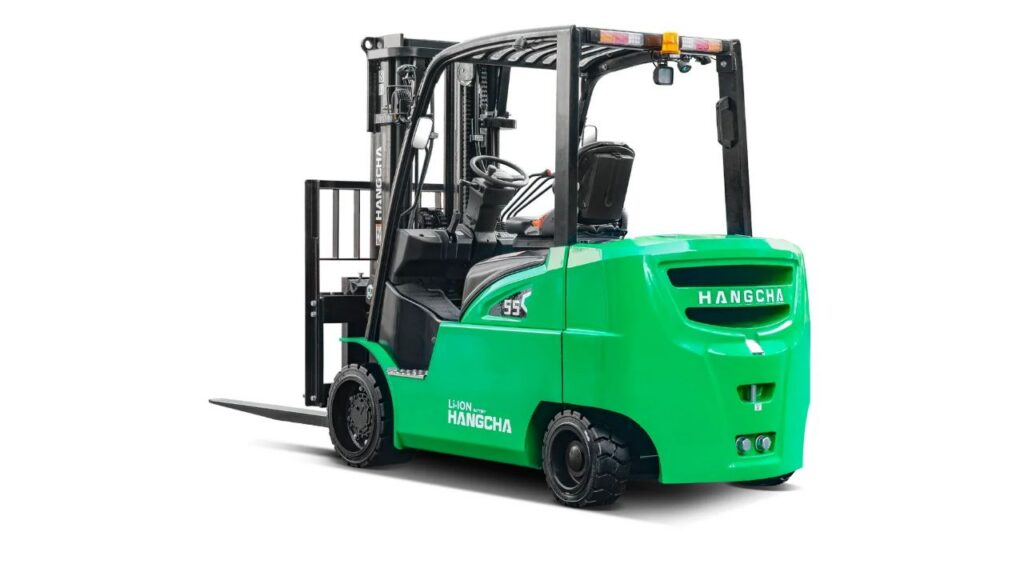
A cushion forklift tyre is a band of solid rubber bonded to a steel ring, which is pressed straight onto the wheel hub. There's no air inside and no rim to split, so it can't go flat. The tyre is small in diameter with a thin wall, so the whole truck sits lower and the maker can shorten the wheelbase.
Hangcha's XC and XF cushion ranges come from its North American line, where cushion tyre trucks are the standard warehouse forklift. Their capacities are rated at a 600 mm load centre, not the 500 mm used on the pneumatic Hangcha counterbalance forklifts we sell up to 3.8 t. The XC Series 2.5 t carries 2,270 kg at 600 mm and the XA III 2.5 t carries 2,500 kg at 500 mm, so the cushion truck isn't weaker: the two figures are measured at different points on the forks.
Cushion tyres aren't limited to light loads either. The XC Series 6-7 t and the XF Series LPG 6-7 t both carry up to 7,000 kg, and the XF 6-7 t still lifts 5,800-6,800 kg at 6.2 m. On the XF Series LPG 1.4-2.9 t, smooth cushion tyres are standard, with traction and non-marking cushion tyres as options.
Pneumatic forklift tyres come in air and solid
Pneumatic forklift tyres are the large, treaded tyres on yard and dual-use forklifts, and they come in two builds that suit the same kind of truck. Both stand taller than a cushion tyre, which lifts the chassis and gives the truck clearance over bumps.
Air-filled pneumatic forklift tyres
Air-filled pneumatic tyres work like truck tyres: the air carries the load and soaks up bumps. They give the softest ride on rough asphalt and gravel, and the softer ride is easier on the operator, the mast and the load. The weak point is punctures: a nail, a strip of steel banding or broken glass can flatten one in the middle of a shift.
Pressure matters as much as tread. A pneumatic forklift's data plate shows its tyre pressures in kPa, and Safe Work Australia's general guide for industrial lift trucks puts tyre wear, damage and inflation on the pre-start check for pneumatic types.
Solid pneumatic forklift tyres
Solid pneumatic tyres are solid rubber moulded to the shape of an air tyre. They can't puncture, so they're the usual choice for yards with steel offcuts, scrap, glass or nails. The ride is firmer than air and softer than a cushion tyre. Hangcha offers solid tyres as an option on the A Series diesel forklift 1.5-3.8 t, and the XF Series 1-3.5 t runs on pneumatic or solid tyres depending on the model.
Cushion tyre forklifts turn tighter in narrow aisles
A cushion tyre forklift turns tighter than a pneumatic forklift of the same capacity, because its small wheels let the maker shorten the wheelbase and the body. The 2.5 t model in the Hangcha XC Series 1.8-3.5 t is only 1,070 mm wide. Its aisle figure and that of the pneumatic XA III Series 2.5 t are both measured with a 1000 x 1200 mm pallet carried crossways.
| Model (2.5 t electric) | Tyres | Rated capacity | Turning radius | Aisle needed |
|---|---|---|---|---|
| XC Series CPD25 | Cushion | 2,270 kg at 600 mm | 1,750 mm | 3,377 mm |
| XA III Series CPD25 | Pneumatic | 2,500 kg at 500 mm | 2,230 mm | 3,982.5 mm |
The cushion truck turns in 480 mm less and needs about 605 mm less aisle. Across a racked warehouse, that's floor space you can give back to racking instead of driving lanes. The LPG pair shows the same pattern: the XF Series cushion FP25C turns in 1,990 mm, and the pneumatic XF Series CPYD25 in 2,245 mm.
The trade-off is where the truck can go. The XA III Series lithium forklift 2-3.8 t works on warehouse floors and in outdoor yards, while the XC stays on the warehouse floor.
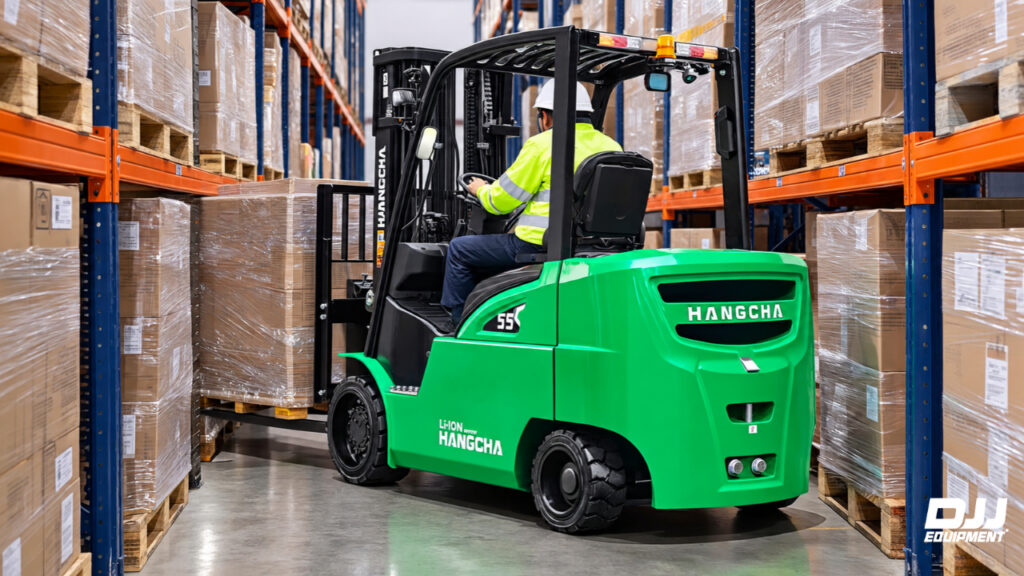
Where a cushion tyre forklift stops working
A cushion tyre forklift stops working where the floor stops being smooth, dry and level. The truck sits low, so dock plate lips, drain covers and broken expansion joints catch the chassis. The tyre has little tread, so wet concrete, loose gravel and painted lines outside offer almost no grip. And with no air in the tyre, every bump goes straight into the mast and the load.
That matters for stability, not just comfort. Safe Work Australia's guide lists driving across slopes or uneven ground among the ways an industrial lift truck can tip over. Compare that with the Hangcha 2WD rough terrain forklift 2.5-3.5 t, which has 235-270 mm of ground clearance on rough terrain tyres.
Distance counts as well as surface. Solid rubber holds heat, so a cushion tyre truck sent on long, fast runs between buildings wears its tyres faster than one doing short trips inside. Even Hangcha's box car and paper roll cushion forklifts, built to load railway box cars and handle heavy paper rolls, are specified for smooth, sealed floors in warehouses, mills and on docks.
Walk the whole route the forklift will drive, not just the main floor. One gravel strip between the warehouse and the container park is enough to rule out cushion tyres.
Can you put pneumatic tyres on a cushion tyre forklift?
No. You can't put pneumatic tyres on a cushion tyre forklift, or cushion tyres on a pneumatic forklift. Cushion tyres press onto a plain hub, while pneumatic tyres mount on a rim, and the two need different wheel arches, axles and ride heights. The counterweight, mast height and load chart are set for the tyre the truck left the factory with, so a different tyre height changes how the truck lifts and how stable it is.
You can change the tyre within its own type. On a cushion truck, smooth tyres can give way to traction or non-marking cushion tyres, which the XF Series LPG 1.4-2.9 t offers as options. On a pneumatic truck, air tyres can give way to solid pneumatic tyres of the same size, an option Hangcha offers on the A Series and XF Series.
If you already own a cushion tyre forklift and the work has moved outside, the fix is a different forklift, not different tyres.
How forklift tyre maintenance differs by type
Cushion and solid pneumatic tyres need less daily care than air tyres, because there's no pressure to check and nothing to puncture. Air tyres need the pressure on the data plate, checked at every pre-start, and a look for cuts and embedded steel. Solid tyres are replaced on wear and damage: chunks out of the tread, cracks near the base, or rubber worn down to the limit the tyre maker marks.
Running cost follows the ground. On a clean floor, cushion tyres are the simplest of the three to keep. In a yard full of debris, air tyres cost the least to buy, but punctures and lost shifts add up, which is why solid pneumatic tyres usually pay their way there. On a hired forklift, tyres are charged to the hirer as assessed by DJJ, so match the tyre to the ground before the machine arrives.
Replacement forklift tyres and wheels come through our parts team at Silverwater NSW, Meadowbrook QLD and Bayswater WA, and on-site service covers sites within 50 km of each branch.
Which forklift tyre suits your site?
The right forklift tyre is the one that suits the roughest stretch of the route, not the floor where the truck spends most of its day.
Indoor only, on smooth concrete
Choose cushion tyres. The electric XC Series runs on lithium-ion batteries from 1.8 to 7 t and suits enclosed or noise-sensitive buildings with charging space. The LPG XF Series refuels quickly with 43-47 kW engines on the 1.4-2.9 t models, but needs adequate ventilation indoors.
A warehouse floor plus a sealed yard
Choose air pneumatic tyres on a counterbalance forklift. The best forklift for indoor and outdoor use on that kind of site is usually a pneumatic-tyred electric truck such as the XA III Series, which carries 2-3.8 t and climbs a laden grade of 15-18%.
Yards with steel, glass or scrap
Choose solid pneumatic tyres. They take the same punishment without the flat tyres, which is why they're an option on the A Series diesel forklift from 1.5 to 3.8 t. Expect a firmer ride than air tyres on broken ground.
Gravel, dirt and slopes
Choose a forklift built for the ground, not just a tyre. Rough terrain forklifts run on deep-tread pneumatic tyres with far more clearance: the Hangcha 2WD 2.5-3.5 t has 235-270 mm and a 2,900 mm turning radius, so it needs more room than any warehouse truck.
Send us the load weight, the lift height and a few photos of every floor and yard the forklift will cross, and we'll recommend a truck on the right tyres to buy or hire. Call 1800 355 388 or send an enquiry through the website.