An order picker forklift is an electric warehouse truck that lifts the operator together with the forks. The operator stands on a platform with the controls and picks cartons or single items by hand, straight from the racking. It's built to fill orders, not to put away full pallets. In Australia, the operator needs a high risk work licence class LO, not the LF class used for other forklifts.
How an order picker forklift works
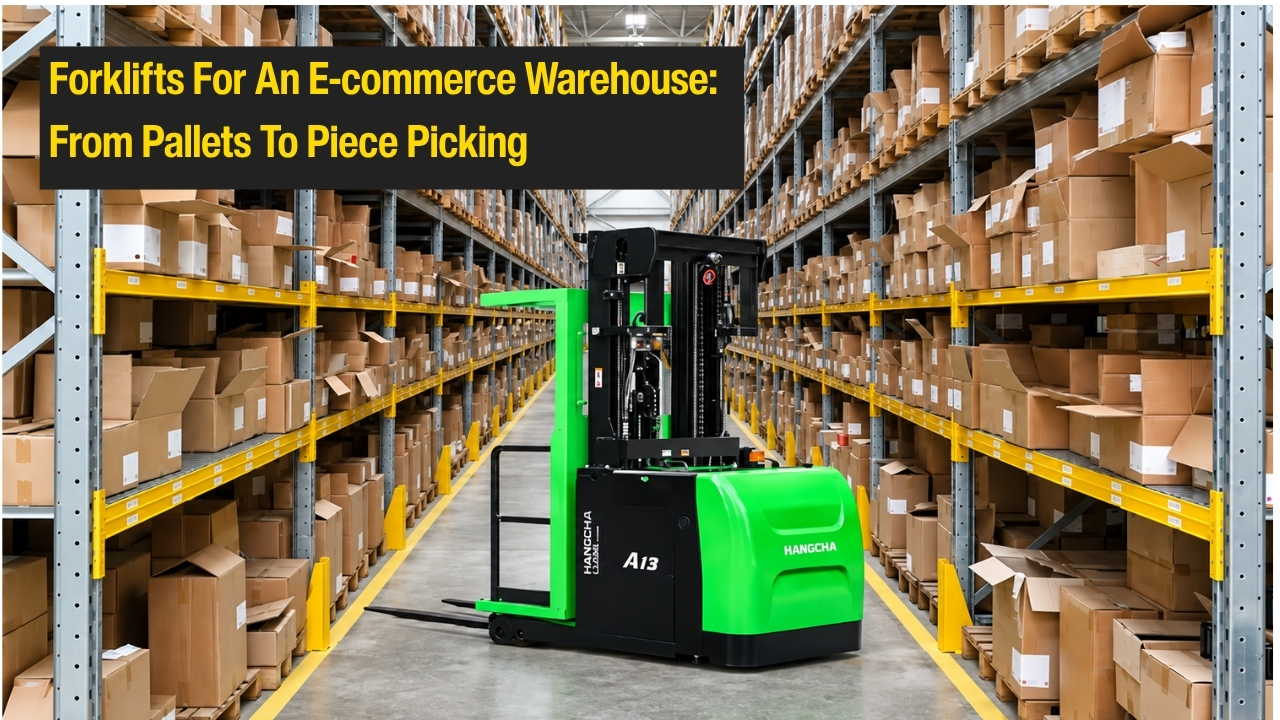
An order picker carries the operator on a platform fixed to the lifting carriage, so the operator, the controls and the forks rise together. The operator drives to the pick location, raises the platform to the shelf and moves stock onto the pallet on the forks.
Safety systems are built around the platform. The Hangcha A Series narrow aisle 1.3 t has guardrails with detection switches and a safety pedal as standard. Its travel speed drops from 12 km/h below 500 mm of lift to 1 km/h above 4.9 m.
Hangcha order pickers are battery-electric, running on lead-acid or lithium iron phosphate (LFP) batteries. On the Hangcha 1.2 t, the LFP battery charges fully in 2 hours, against 8-10 hours for lead-acid.
Types of order pickers by lift height
Order pickers are grouped by how high the operator goes. DJJ Equipment sells Hangcha order pickers in each group, and the figures below are Hangcha's.
| Type | Forks lift to | Main job | Licence |
|---|---|---|---|
| Low-level order picker | About 125 mm | Picking from the lowest rack levels | Grey area: check the model with your regulator |
| Medium-level order picker | 3.0-4.5 m | Picking in racking below about 5 m | LO |
| High-level order picker | 4.5-9.5 m | Picking in high-bay racking from 5 m to 10 m | LO |
| Man-up VNA turret truck | Up to 14.7 m | Picking and putting away full pallets in very narrow aisles | LO |
Your top pick location sets the type. Capacity then falls as the forks go up.
Low-level order pickers
A low-level order picker moves a pallet just clear of the floor while the operator picks from the lower rack levels. The X Series low-level order picker carries up to 2,500 kg, and its forks lift only 125 mm. On the lifting-platform version, the operator rises to 1,030 mm.
Low-level pickers sit in a licence grey area. Their forks can't rise 900 mm, so many may fall outside the legal definition of a forklift truck, and so outside class LO. Confirm the exact model with your state regulator, and train operators either way.
Medium-level order pickers
A medium-level order picker lifts the operator and the forks together to about 3-4.5 m. The A Series medium-level order picker comes with a 3,000 mm or 4,500 mm lift. Some versions add an 800 mm auxiliary lift that raises the pallet towards the operator.
High-level order pickers
A high-level order picker works in high-bay racking from about 5 m to 10 m. At that height, the capacity at your top shelf matters more than the headline figure.
The A Series high-level order picker 1.2 t has masts from 4.5 m to 9.5 m and a platform height of up to 9,766 mm. It carries 1,200 kg up to 3 m of lift, 1,000 kg at 5 m and only 400 kg at 9.5 m. Those figures use a 400 mm load centre.
Man-up VNA turret trucks
A man-up VNA turret truck also lifts the operator, but its forks rotate and reach sideways to put away full pallets on both sides of the aisle. The Hangcha X Series man-up tri-lateral stacker reaches 14.7 m on its largest model and 10.2 m on the others.
Order picker vs forklift: what's the difference?
An order picker is a type of forklift truck that lifts the operator, while other forklifts keep the operator at floor level. The table compares the three machines.
| Order picker | Reach truck | Counterbalance forklift | |
|---|---|---|---|
| Operator position | On a platform that rises with the forks | At floor level | At floor level |
| Main job | Picking cartons and single items | Putting away and retrieving full pallets in racking | Moving pallets, loading trucks and containers |
| Where it works | Indoors on smooth, level floors | Indoors on smooth, level concrete | Indoors, yards, docks and ramps |
| Aisle | Very narrow when guided, wider when free-ranging | About 2.6-2.9 m (Hangcha) | About 3.9-4.1 m (2.5 t) |
| Licence class | LO | LF | LF |
Only the order picker carries a fall-from-height risk, so only it needs harness rules. For the two floor-level machines, this reach truck vs counterbalance forklift comparison covers aisles, lift height and loading trucks.
What else is an order picker called?
An order picker is also called a stock picker, a man-up truck or, in WHS law, an order-picking forklift truck. A cherry picker is usually a different machine: a boom-type elevating work platform that lifts people, not stock. Order picker is also the name of a warehouse job, picking and packing customer orders.
The name stock picker is used loosely, and small tray units are often sold as work-assist vehicles or elevating work platforms. If the forks can rise 900 mm or more and the controls rise with them, treat it as an order picker needing LO.
Do you need a licence to drive an order picker?
Yes, an order picker needs a high risk work licence class LO in Australia. In law, it's a forklift truck whose operator controls rise with the lifting media.
Class LF covers every other forklift truck, including reach trucks and counterbalance forklifts. An LF holder still needs LO for an order picker, and LO doesn't cover a reach truck or counterbalance forklift.
To get an LO licence, you complete the unit TLILIC0004 with a registered training organisation (RTO) and pass the national assessment. Then apply to your state regulator, such as SafeWork NSW, WorkSafe Queensland or WorkSafe WA, within 60 days. Passing the unit alone isn't a licence, and you must be at least 18. Course length and fees vary by RTO and state.
A trainee may operate an order picker only while training for the licence, under the supervision of a licensed operator. The WorkSafe WA fact sheet on the LO licence class describes the machines it covers.
Working safely at height on an order picker
A fall from the platform is the main risk on an order picker. WHS law sets the order: remove the fall risk if you can, then prevent falls, then use work positioning, and use fall arrest last. On most order pickers that means gates or guardrails plus a full-body harness, clipped to the maker's anchor point whenever the platform is raised.
If operators use a harness and lanyard, the business must set up rescue procedures, test them and train the people involved. Plan how to lower the platform from the ground. Select and maintain harnesses to AS/NZS 1891.4:2025 and the maker's instructions.
Day-to-day controls matter as much as the harness:
- A pre-start check every shift, covering the truck, harness, lanyard, anchor, gates and interlocks. Tag out any defect.
- Pedestrians kept out of the aisle while the order picker works, with barriers or chains at aisle ends, floor markings and signs.
- At least 3 m between people and any forklift, as WorkSafe Victoria recommends, and more when the load is raised.
- Racking maintained to AS 4084.2:2023, with a safe working load sign for each beam level.
- Staying within the data plate, and slowing down with the platform up.
Can two people ride on an order picker? Only carry the number of people the data plate and the maker's manual allow.
Where an order picker fits, and where it doesn't
An order picker fits warehouses that pick many small orders from racking, such as e-commerce, third-party logistics, spare parts and retail distribution. It's the wrong machine for full pallets going in and out of racking all day: that's reach truck or VNA work. It's also wrong outdoors or on rough floors. Chilled and frozen rooms need a cold-store specification, so ask DJJ which models suit before you plan one.
Aisle layout decides the setup. A guided truck follows a floor wire or steel rails, in an aisle only a few hundred millimetres wider than the truck. A free-ranging order picker needs far more room: the A Series medium-level model needs a 3,235 mm aisle for a 1000 x 1200 mm pallet crossways.
How to choose an order picker for your warehouse
Choosing an order picker starts with your top pick height and the weight you'll lift there. Those two figures also drive most of what an order picker costs, new or used. Check these points before you ask for a quote:
- Top pick height, which sets the type.
- Load at that height, read from the load chart at the right load centre.
- Aisle width and guidance, checked against the maker's drawing for your racking.
- Floor flatness, especially for guided aisles and tall masts.
- Shift pattern: lithium can be topped up in breaks, while lead-acid needs a full charge between shifts.
- Who will drive it, and whether they hold an LO licence.
If your racking will grow, we'd usually size the mast for the future top level and check the capacity there. A truck that only just reaches today's top beam leaves no room to add a level.
An order picker is the right machine when people need to pick by hand at height. DJJ sells Hangcha order pickers, and hires selected models, from Silverwater NSW, Meadowbrook QLD and Bayswater WA. Most carry a 24 month / 2,000 hour warranty. Call 1800 355 388 with your top pick height, heaviest load and aisle width, and the team will suggest options to buy or hire.