
Forklift trade-in value is worked out from the machine's hours, its battery or engine condition, its service history, its overall wear, any attachments and how easily a dealer can resell it. Hours usually matter more than age, and a full set of service records helps more than a fresh coat of paint. The dealer compares the forklift with similar used ones, then allows for the cost of reconditioning and resale. Most forklifts can be traded in whatever the brand, but a trade-in usually pays less than a well-run private sale, in exchange for less work and less risk.
When does a forklift trade-in value become final?
A forklift trade-in value starts as an indicative figure, based on the make, model, year, hours, photos and service records you send and on what similar used forklifts are selling for. It becomes final only after the machine is checked and function-tested, because photos don't show a stretched chain or a weak battery. The agreed figure then comes off the price of the new forklift.
Forklifts of all brands are accepted through DJJ's forklift trade-in service when you buy a new machine, and the indicative figure holds as long as the forklift matches the details and photos you sent.
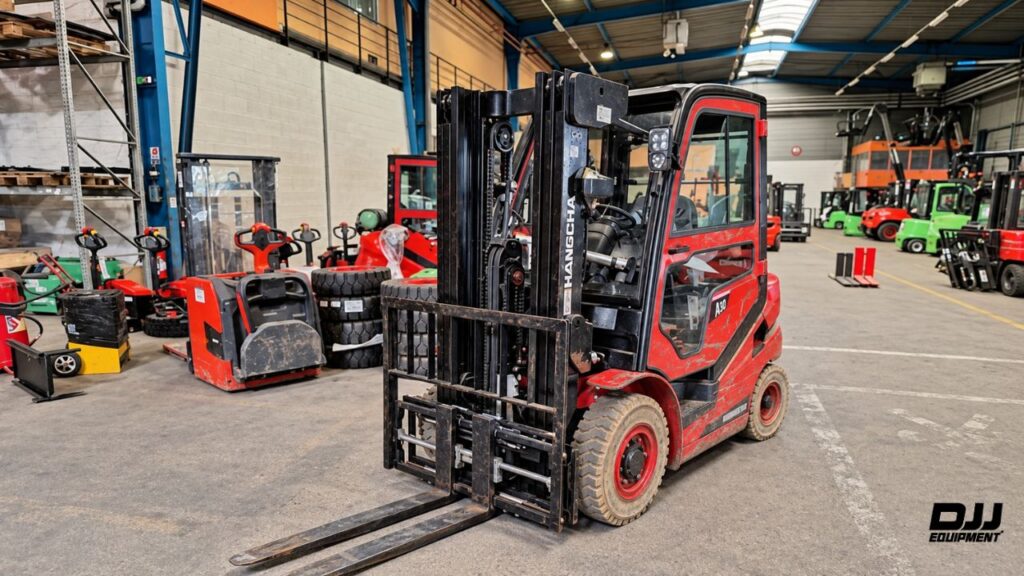
What raises or lowers forklift trade-in value
Forklift trade-in value rises with low hours, documented servicing and a healthy battery or engine, and falls with heavy wear, missing records and an unusual spec. The table shows what a valuer looks at and how you can check it first.
| Factor | Why it matters | How to check |
|---|---|---|
| Operating hours | Hours show how much work the drive, hydraulics and mast have done | Photograph the hour meter and check the reading fits the service records |
| Service history | Records show the forklift was looked after and that wear parts were replaced on time | Gather service reports and repair invoices |
| Battery condition (electric) | The battery is one of the dearest parts of an electric forklift. A tired battery cuts run time and the value | Get a battery test report, or the health reading from a lithium battery's management system. Include the charger |
| Engine condition (LPG or diesel) | Hard starting, smoke or oil leaks point to repairs the next owner will pay for | Note how it starts from cold, any warning lights and any leaks |
| Mast, chains and forks | Worn fork heels, stretched chains or play in the mast need repair before resale | A technician measures fork wear and chain stretch against the manufacturer's limits |
| Tyres and body | Worn tyres, dents and a damaged overhead guard reduce appeal and may need fixing | Photograph each side |
| Attachments | A side shift or fork positioner makes a forklift easier to resell. Specialist attachments add value only if a buyer needs them | List each attachment and check it is shown on the data plate |
| Data plate and load chart | Without a readable data plate, the rated capacity can't be confirmed | Check the plate is fitted, legible and matches the attachments on the machine |
| Working environment | Cold stores, corrosive sites and very dusty yards wear components faster | Say where the forklift worked |
| Market demand | A mainstream capacity, mast and power type sells faster than a rare spec | Ask what similar used forklifts are selling for |
Why hours matter more than age
A forklift with low hours and good records can be worth more than a newer machine that has run double shifts. Age still counts, because parts for an older forklift can be harder to find. There is no single hour reading where value drops away: the machine type, its servicing and its battery or engine all change the answer.
Forklift trade-in vs private sale vs auction
Selling your forklift privately usually returns the most cash, a trade-in is usually the least work, and an auction is quick but leaves the price to the bidders on the day. The table compares the three on cash, effort and risk.
| Option | Cash you receive | Effort | Risk |
|---|---|---|---|
| Trade-in | Usually less than a private sale, because the dealer must recondition and resell | Low: one transaction alongside the new forklift | Low: the value is agreed before you commit |
| Private sale | Often the highest, if you find the right buyer | High: advertising, enquiries, inspections and paperwork | Payment scams, buyers who back out and disputes after the sale |
| Auction | Hard to predict, and fees come off the result | Medium: listing and inspections | It can sell for less than you hoped unless you set a reserve |
If you're buying a new forklift anyway, a trade-in turns the old one into a lower purchase price in a single deal. If you aren't replacing it, or it's a sought-after machine in good order, a private sale may be worth the extra time.
What is an old or high-hour forklift worth as a trade-in?
An old or high-hour forklift can usually still be traded in, and what it is worth depends more on what the next owner would have to spend on it than on its age. A machine that starts, drives and lifts safely, with records to back it up, keeps a resale value. A failed battery, a major engine fault or structural damage can bring the figure down to little more than parts or scrap metal. Condition also decides whether to repair or replace the forklift in the first place: a sound frame, mast and drive point to a repair, several major parts due at once to a replacement.
If a big repair is coming, such as a new battery or engine work, get a valuation before you spend the money. A major repair rarely adds as much to the trade-in value as it costs. Whether you can trade an old forklift against a newer second-hand model depends on the dealer and the stock it holds. DJJ takes trade-ins against new forklifts.
If the old machine mainly covered busy periods, weigh up forklift hire vs buying before you replace it like for like.
How to prepare your forklift for a trade-in valuation
Preparing a forklift for a trade-in valuation means collecting the evidence a valuer would otherwise have to guess at. Have these ready when you ask for a figure:
- a clear photo of the hour meter and the data plate
- photos of all four sides, the mast, the forks and the tyres
- service records, inspection reports and repair invoices
- battery details and the charger for an electric forklift, or a note on how an LPG or diesel engine starts and runs
- a list of attachments, plus the keys and manuals
- a payout figure from your lender if there is finance owing
A clean machine is easier to assess, so a wash is worth the time. Be upfront about faults: a figure based on full disclosure is less likely to change at inspection.
Does finance owing reduce what you get for a forklift trade-in?
Yes, in effect. A forklift with finance owing can usually still be traded in, but the loan has to be paid out before ownership can pass, so what you end up with is the trade-in value less the payout. Lenders often register their interest in financed equipment on the Personal Property Securities Register (PPSR). A dealer or private buyer can search the register by the forklift's serial number for a small fee, and a registered interest means the lender may still have a claim on the machine after it's sold.
Ask your lender for a payout figure before you get a valuation. If the payout is more than the trade-in value, you'll need to cover the difference. Once the loan is cleared, ask the lender to remove its registration.
If you plan to finance the replacement, forklift finance is arranged through our finance partner, and pre-approval is no-cost and obligation-free.
Trading in a business forklift can also have GST and income tax effects, so check the treatment with your accountant before you agree a figure.
A trade-in won't always pay the most, but it's the simplest way to turn an old forklift into a lower price on one of DJJ's new forklifts.
For a figure on your machine, send the hours, year, photos and service records through the forklift trade-in appraisal form, or call 1800 355 388, and the Silverwater, Meadowbrook or Bayswater branch will value it.