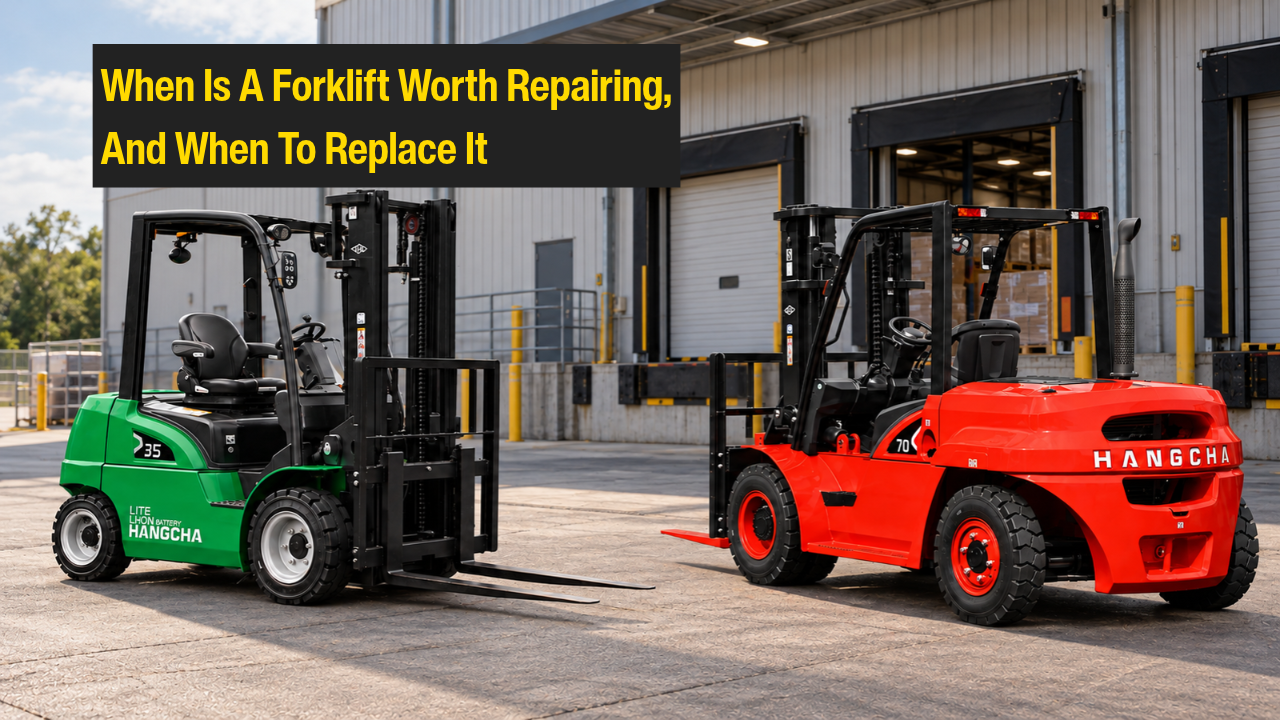
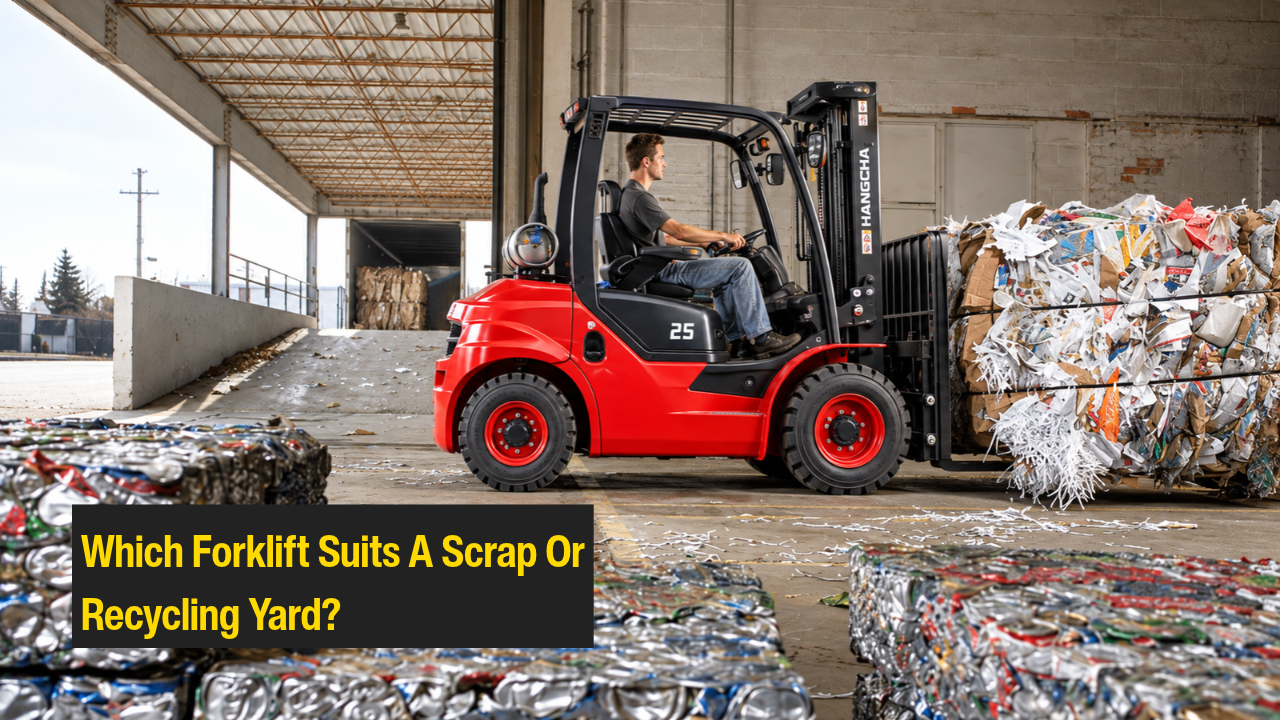
A side shift slides the whole fork carriage left or right, so the operator lines up a pallet without moving the forklift. A fork positioner changes the gap between the forks from the seat, so one truck picks up loads of different widths. Choose side shift when pallets are one size but placing is tight, a fork positioner when load widths change through the shift, and a side-shifting fork positioner when you get both. Both cost capacity: on the Hangcha XA Series, rated from 2 to 3.8 tonnes at a 500 mm load centre, an integral sideshifter takes 100 kg off the rated load and a hook-on one 150-200 kg.
The table compares the two attachments, and the unit that combines them, on Hangcha trucks.
| Feature | Side shift (sideshifter) | Fork positioner | Side-shifting fork positioner |
|---|---|---|---|
| What moves | The whole carriage and both forks, sideways together | Each fork, towards or away from the other | Both: fork spread and sideways shift |
| What stays fixed | The gap between the forks | The position of the carriage | Neither |
| Suits | One pallet size, tight placing in racking, containers or on truck decks | Load widths that change through the day | Mixed widths and tight placing |
| Capacity cost on Hangcha trucks | Integral 100-400 kg, hook-on 150-500 kg, by model | No fixed figure published: read the load chart with it fitted | No fixed figure published: read the load chart with it fitted |
| Standard or option | Standard on the A Series reach truck 1.2-2 t; an option on the X Series 1.5-3.8 t and 5-10 t diesel and LPG trucks | Standard on the 8.5-10 t models of the X Series 5-10 t; an option on its 5-7 t models | An option on the X Series 5-10 t |
Each attachment changes what the other keeps fixed: a side shift moves the load and keeps the fork gap, while a positioner moves the forks and leaves the carriage where it is. Across the Hangcha range DJJ Equipment sells, standard fitment varies by model, so check whether a quote includes either one.
What does a forklift side shift do?
A forklift side shift moves the fork carriage, both forks and the load left or right with hydraulics, while the gap between the forks stays the same. The operator lines up a pallet with the rack beam or a gap on a truck deck without reversing and turning in again. Fewer corrections mean fewer knocks on racking and pallets, and quicker placing in tight spots.
Side shifters come in two builds. An integral sideshifter replaces the standard fork carriage, while a hook-on (external) unit hangs on the carriage the truck already has. On the X Series diesel and LPG 1.5-3.8 t, Hangcha lists the sideshifter as an optional attachment. The XA Series 2-3.8 t comes with a standard fork, fork carriage and load backrest, with no sideshifter in its standard specification.
What does a fork positioner do on a forklift?
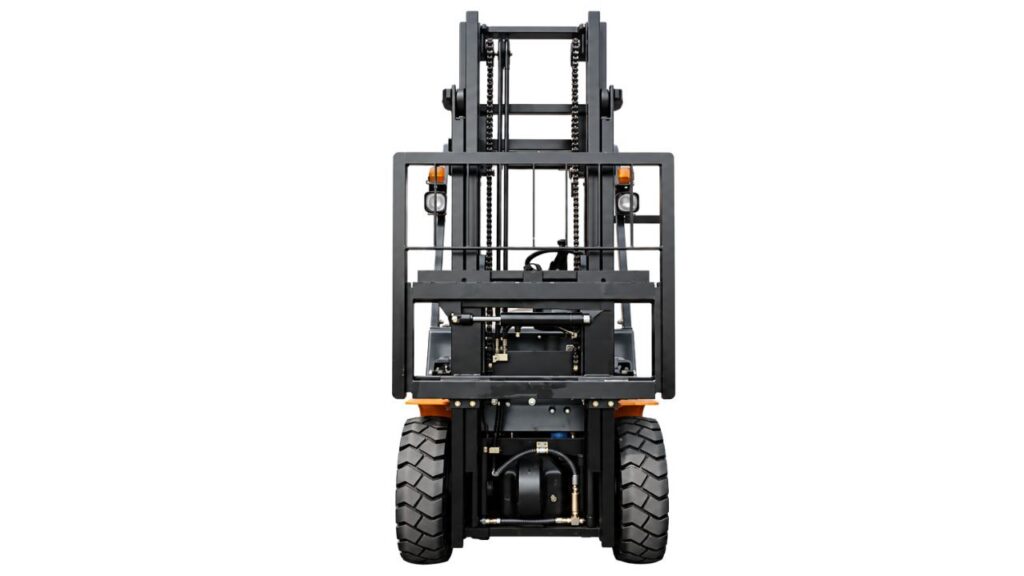
A fork positioner moves the two forks apart or together with hydraulics, controlled from the operator's seat. It replaces climbing off and sliding each fork along the carriage by hand. A plain positioner doesn't move the load sideways; that takes a side-shifting fork positioner. Both forks need to move evenly, because a load picked up off-centre sits unevenly on the truck.
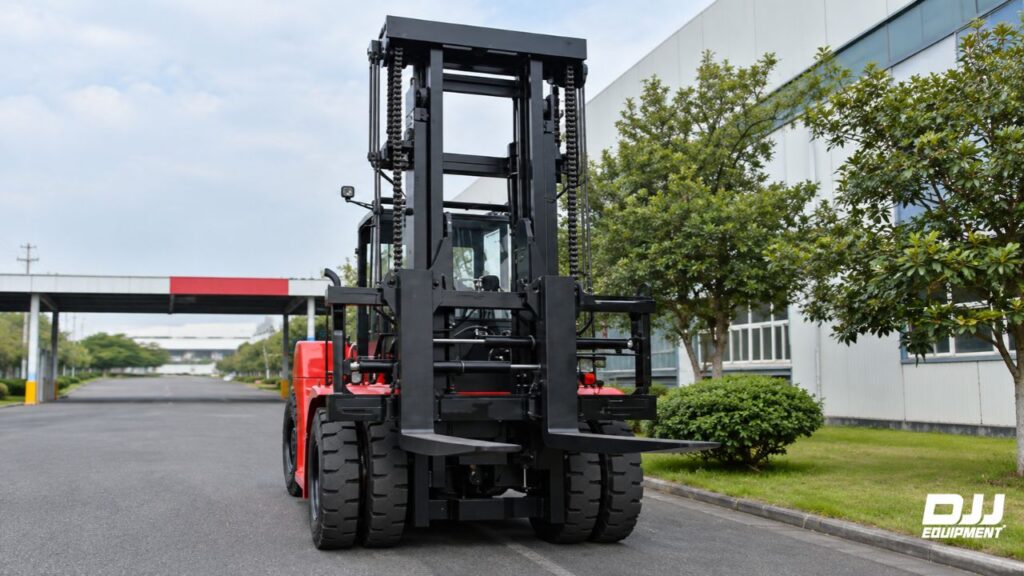
Hangcha fits a fork positioner as standard on the 8.5-10 t models of the X Series 5-10 t diesel and LPG forklift, rated at a 600 mm load centre. Those models also carry 1,520 mm forks and a 2,197 mm wide body for long and wide loads. The 5-7 t models have 1,220 mm forks and a 1,990 mm body. On them, the fork positioner, the side-shifting fork positioner and the sideshifter are all optional attachments.
Hangcha doesn't publish a fixed capacity deduction for the positioner. The figure that counts is on the load chart for the truck with that positioner fitted.
How much capacity does a side shifter take off a forklift?
A side shifter takes 100-500 kg off a Hangcha forklift's rated capacity, depending on the model and on whether it's integral or hook-on. Two things cause the loss. The unit's own weight sits in front of the front axle, and its thickness moves the load further from the mast, which pushes the load centre forward. A hook-on unit adds a second layer in front of the carriage, so it costs more than an integral one.
These deductions come from the Hangcha spec sheets, next to the load centre each truck's capacity is rated at.
| Hangcha model | Load centre of the rating | Integral sideshifter | Hook-on (external) sideshifter |
|---|---|---|---|
| XE Series 1.5-3.8 t | 500 mm | 100 kg | 150 kg (1.5-2.5 t), 200 kg (3-3.8 t) |
| XA Series 2-3.8 t | 500 mm | 100 kg | 150 kg (2-2.5 t), 200 kg (3-3.8 t) |
| X Series diesel and LPG 1.5-3.8 t | 500 mm | 100 kg | 150 kg (1.5-2.5 t), 200 kg (3-3.8 t) |
| XH Series Heavy Duty 4-5 t | 500 mm | 100 kg | 200 kg |
| X Series diesel and LPG 5-10 t (5-7 t models) | 600 mm | 200 kg | 300 kg |
| XH Series Heavy Duty 6-10 t | 600 mm | 200 kg | 300 kg |
| Rough terrain 2.5-3.5 t (lithium and 2WD diesel) | 500 mm | 200 kg | 300 kg |
| XF Series 5-7 t | 600 mm | 400 kg | 500 kg |
The deduction grows with the truck, from 100 kg on the 1.5-3.8 t electric, diesel and LPG trucks to 400-500 kg on the XF Series 5-7 t. On every line, the hook-on unit costs 50-100 kg more than the integral one. So if a sideshifter is going on a new truck, the integral build keeps more of the rating.
Say you're looking at the 2.5 t model of the XA Series 2-3.8 t, rated at 2,500 kg at a 500 mm load centre. With a hook-on sideshifter it carries 2,350 kg, and with an integral one 2,400 kg. Those figures hold only on masts where the chart allows the full 2,500 kg, because the rating falls on the taller masts.
Forklift load plate rules with a side shift or positioner fitted
The forklift's load plate has to match the attachment on the truck. SafeWork NSW says the load rating plate should be readable, list the forklift's capacity and list any attachment used with its working load limit (WLL). For forklift attachments, it also asks for the maker or agent, the model, a serial number where there is one, the load rating, the horizontal and vertical centre of gravity and the attachment's weight.
WorkSafe Queensland's guidance on using forklift attachments says side shift devices need a rated capacity and information on safe use. The forklift maker's manual should confirm the attachment is safe on that model. With an attachment fitted, the forklift may need to be de-rated and some controls restricted, and operators need extra training on the attachment, the load plate and the risks of the task.
Fork positioners fall under the same rules. Because Hangcha publishes no fixed deduction for one, ask for the load chart for the truck with that exact positioner fitted. If you add or change an attachment later, the old plate no longer describes the truck.
Which loads need a forklift side shift, a fork positioner or both?
Two questions settle it: do your loads come in one width, and how tight is the spot you set them down in? The answers point to one of three set-ups.
Same-size pallets in tight racking, containers or truck decks
Choose a side shift. If every pallet is the standard 1165 mm Australian pallet, the fork gap rarely changes. The operator still has to land each pallet square on a beam or inside a container, and the side shift does that last bit of lining up without moving the truck.
Pallet and load widths that change through the shift
Choose a fork positioner. Hangcha spec sheets give aisle widths for 1000 x 1200 mm and 800 x 1200 mm pallets, sizes that differ from the 1165 mm Australian pallet. Add timber, steel or unpalletised crates and the width changes again. If one forklift handles all of these, each change means resetting the forks, and a positioner does it from the seat.
Both in one shift
Choose a side-shifting fork positioner, which spreads the forks and shifts the load in one unit. It's an option rather than standard, even on the X Series 5-10 t. It also puts more hydraulics on the carriage, so check the load chart with it fitted and make sure the truck's valve has enough functions to run it.
Paper rolls, bales and drums need a clamp instead, and the X Series diesel and LPG 1.5-3.8 t has paper roll, bale and drum clamps among its options. Each of these types of forklift attachments takes capacity off the truck as well.
Does a reach truck need a side shift?
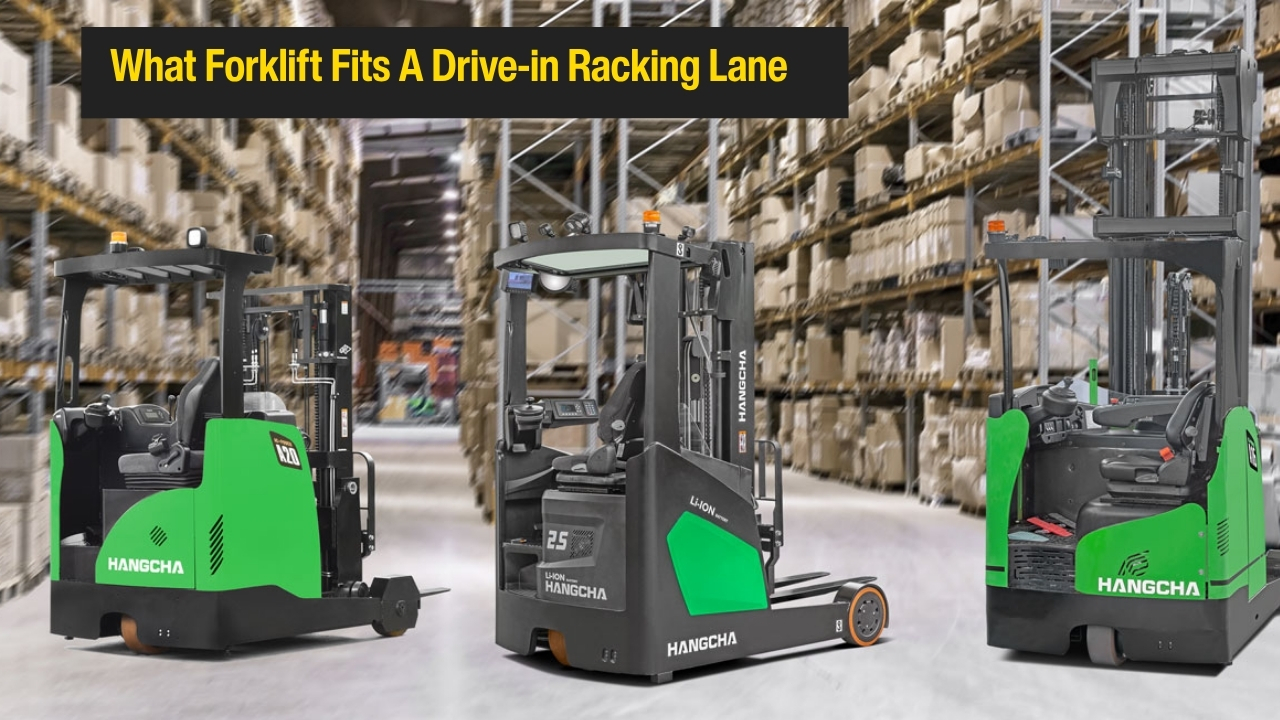
A reach truck gains a lot from a side shift, because it places pallets on high beams in narrow aisles with little room to reposition. Not every reach truck has one built in, though. The A Series reach truck 1.2-2 t has a built-in sideshifter and fork tilt as standard, lifts up to 12.5 m and is rated at a 600 mm load centre.
On the A Series reach truck 1.5-1.8 t, the integral sideshifter is an option. Its capacities are rated at a 500 mm load centre without a sideshifter, and fitting one takes 200 kg off. The XC Series reach truck 1.4-2.5 t, which lifts up to 13 m, has a central sideshift on fingertip-control versions that brings the forks back to the middle automatically. When you compare reach trucks, check whether the quoted capacity includes the sideshifter.
Can you add a side shift or fork positioner to an existing forklift?
A hook-on side shift or fork positioner can go on an existing forklift when it's designed and matched for that truck, as WorkSafe Queensland requires. The carriage class has to suit. The X Series diesel and LPG 1.5-3.8 t has a class II (III) fork carriage, the XA Series 2-3.8 t an ISO 2328 class 3A carriage and the 5-7 t models of the X Series 5-10 t class IV A. The XA Series comes with a two-way multi-way valve as standard, with triple and quadruple valves as options, so count the valve functions before choosing a hydraulic attachment.
Before supplying side shifters and fork positioners, DJJ reviews seven points: the equipment brand and model, its rated capacity, the mounting or carriage type, the hydraulic requirements, the attachment's weight and load centre, the load dimensions and the operating environment. An attachment can reduce usable capacity, so compatibility is confirmed before use.
Once it's fitted, the load plate needs to show the attachment and its WLL. If you're buying a new truck instead, check whether each quote includes a side shift or positioner, because a forklift with a sideshifter and one without aren't priced like for like.
Before you choose, measure your narrowest and widest loads, and note the heaviest load and the highest beam it goes on. Send those figures with the truck model, and our team can check the load chart with the attachment you need. Call 1800 355 388 or send an enquiry to your nearest branch.