The right forklift for a farm or produce yard depends on three things: what you lift, the ground you lift it on and how many hours the machine runs in the busy season. Paddocks, orchard rows and dirt tracks need a rough terrain forklift, while a packing shed with a concrete floor can run a standard counterbalance forklift. Cool rooms and enclosed sheds call for an electric machine, because engine exhaust builds up indoors. If the heavy work only lasts a few months of harvest, hiring for the season can make more sense than buying.
What a farm forklift has to lift
Farm loads are rarely neat warehouse pallets. A typical farm or produce yard moves:
- bins of fruit and vegetables, from the paddock to the packing shed
- hay and straw bales
- pallets of feed, fertiliser, seed and chemicals
- fence posts, irrigation pipe and building supplies
Weight changes with the weather. A wet bale or a bin of freshly washed produce weighs more than the same load dry, so weigh your heaviest load at its wettest before you choose a capacity.
Size matters as much as weight. Hangcha rough terrain forklifts up to 3.5 tonnes are rated with the load's centre 500 mm from the fork face, and the 5-10 t models at 600 mm. A large bale or a deep bin moves that centre further out, and the forklift can then lift less than its rated figure.
Match the forklift to the ground
Match a 4WD rough terrain forklift to paddocks and orchard rows, a 2WD model to firm gravel yards, and a counterbalance forklift to a concrete shed. The table matches four common work areas with the forklift type, the power that suits it and what to check first.
| Work area | Forklift type | Power | Check first |
|---|---|---|---|
| Paddocks, orchard rows and dirt tracks | 4WD rough terrain forklift | Diesel or lithium | Width between rows, slopes and soft ground after rain |
| Gravel yard around sheds | 2WD rough terrain forklift | Diesel or lithium | Whether the ground stays firm all year |
| Packing shed with a concrete floor | Counterbalance forklift | Electric or LPG | Ventilation if you run LPG |
| Cool rooms and enclosed sheds | Counterbalance forklift | Electric | Charging point and battery suited to the work |
A rough terrain forklift has the clearance, large tyres and drive to work where a warehouse truck would bog or bottom out. A warehouse truck, in turn, turns tighter and fits better between pallets and doors inside a shed.
If you work both paddocks and a concrete shed, you may need two machines, one for each, or one rough terrain machine that can also work indoors. Size whichever you choose for your heaviest load and roughest ground.
2WD or 4WD forklift for farm work?
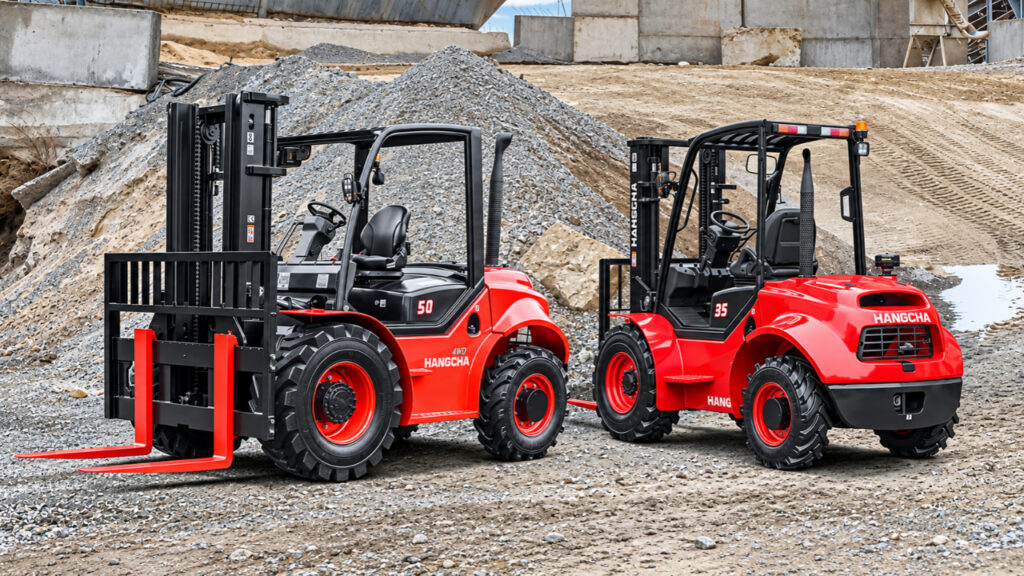
Choose 2WD for firm, dry yards and tracks, and 4WD for mud, sand, loose gravel or steeper ground. 4WD keeps the machine moving when the front wheels start to slip, which is common in orchards and paddocks after rain. Drive is only part of it: an oscillating steer axle and a differential lock also help a rough terrain forklift keep traction and stay level over ruts.
The climbing figures show the gap. On Hangcha's 2.5-3.5 t diesel rough terrain forklifts, laden gradeability is about 22-32% in 2WD and up to 60% in 4WD. The trade-off is space: the turning radius grows from about 2,900 mm to 3,300 mm, and there's more driveline to maintain.
For narrow orchard rows and small yards, the Hangcha 1.5-1.8 t rough terrain forklift is the smallest in the range. It lifts 1,500 or 1,800 kg at a 500 mm load centre, is 1,450 mm wide with 280 mm of clearance at the wheelbase centre, and turns in 2,800 mm in 2WD or 3,200 mm in 4WD. A cabin, heater and OPS system are optional.
Rough terrain forklift or telehandler on a farm?
A rough terrain forklift lifts straight up on a mast, which suits picking up bins and pallets and loading them onto a truck from the side. A telehandler lifts on a boom that reaches forward as well as up, so it can stack bales high, reach into the middle of a trailer or place a load over a wall.
That reach comes at a cost. A telehandler carries its full rating only close in and low down, and capacity falls as the boom extends: the Hangcha X Series 4 t telehandler carries 2,500 kg at full height but 850 kg at full reach with its stabilisers down. Read the load chart for every job, not just the capacity on the nameplate.
Licensing differs too. Forklift operators need a High Risk Work Licence (class LF). A telehandler used with forks or a bucket needs no high risk work licence in NSW, QLD or WA, but operators still need training for the machine.
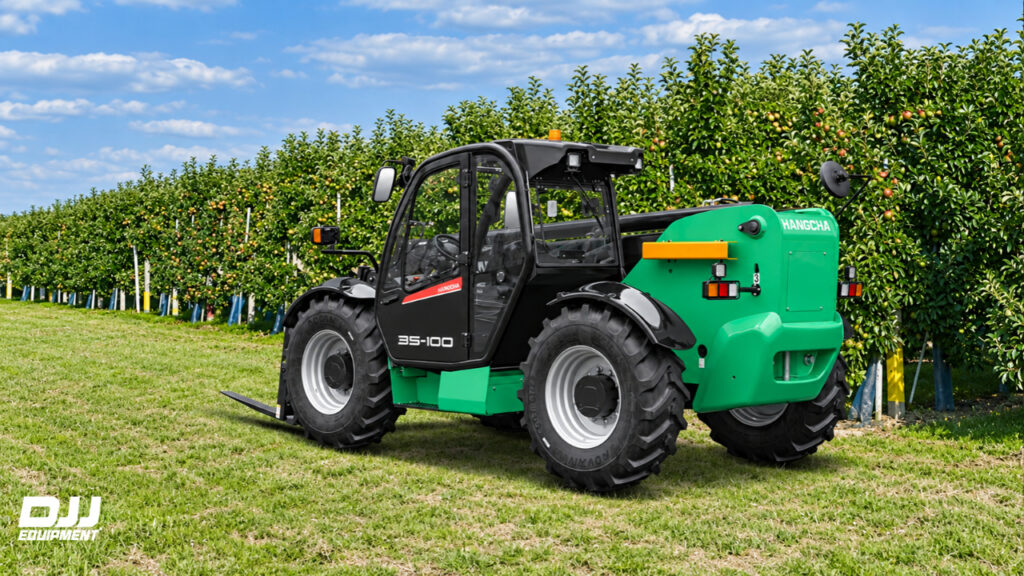
Forklift attachments for bins, bales and bags
Farm forklifts often work with attachments rather than bare forks. Common ones include bin tippers for emptying produce bins, bale clamps and spikes for hay, rotators, fork extensions for long loads and sideshifters for lining loads up on a truck.
Every attachment reduces what the forklift can safely lift, so check the load chart with the attachment fitted. Before you buy one, check it suits your forklift and that the truck has the hydraulic valves it needs. On the Hangcha 5-10 t rough terrain forklift, extra hydraulic valves for attachments are an option, so order them with the machine.
DJJ Equipment supplies forklift attachments including clamps, rotators, fork extensions and specialist forks. Tell the team which forklift it is for.
Forklifts in packing sheds and cool rooms
LPG and diesel forklifts give off carbon monoxide, which builds up quickly in enclosed sheds and cool rooms. Safe Work Australia's limit for carbon monoxide falls from 30 ppm to 20 ppm, averaged over an 8-hour shift, on 1 December 2026.
A 2023 NT WorkSafe safety alert describes two workers in a cool room who suffered carbon monoxide poisoning while an LPG forklift was operating inside, and it advises using pallet jacks or electric forklifts in enclosed or poorly ventilated areas. If your packing shed is open and well ventilated, LPG can still work there, but cool rooms are electric forklift territory.
If one machine has to work the orchard and the shed, the Hangcha high-voltage lithium rough terrain forklift can do both, because it has no exhaust. It lifts up to 3,500 kg on pneumatic tyres, with a differential lock as standard.
Food handling adds one more check. A weeping hydraulic hose or a greasy mast chain above an open bin of produce can drip onto food, so check hoses, cylinders and chains for leaks at every pre-start and fix them before the machine goes back to work.
Keeping a farm forklift running through harvest dust and mud
Keeping a farm forklift running through harvest means cleaning the radiator and air filter far more often. Chaff, straw and dust get pulled into the radiator and can mat across it, and the engine runs hot. Blow out the radiator and engine bay more often in harvest season, and check the air filter, because it clogs faster in dusty paddocks.
Mud wears brakes and hides damage. Wet brakes, which run sealed in oil, handle mud better than open brakes, and they're standard on some heavier machines such as the Hangcha 5-10 t rough terrain forklift. Check tyres and the underside for damage after work in wet paddocks.
When the season ends, wash the machine down, fix anything that wore out during harvest and have it serviced before it's parked. Mud and chaff left on a parked machine hold moisture against metal and wiring for months.
Should you hire or buy a forklift for harvest peaks?
If the forklift works most days of the year, buying usually costs less over its life. A machine that is busy only through a harvest of a few months and idle the rest of the year usually suits hire, so count the hours it will really run each week, in harvest and outside it.
DJJ's forklift hire range includes rough terrain forklifts, and minimum hire terms depend on the machine and branch.
Ask well before harvest starts, so the machine is on site when the first bins come in.
Keeping workers clear of farm forklifts
Forklifts and people often share the same space on farms, especially in sheds and at harvest. In August 2021, a 19-year-old worker was fatally injured in a NSW poultry shed when struck by a forklift carrying a module of cages, and SafeWork NSW told businesses to manage that risk with these controls:
- separate people from moving forklifts with barriers or guardrails, or set exclusion zones where you can't
- consider retrofitting warning devices such as proximity sensors, reverse lights and sensors, flashing lights and beepers
- make sure operators hold the right high risk work licence and are trained on the forklift they use
- add lighting to the forklift where light levels are poor
- talk to everyone who works near forklifts, not only the operators, and provide high-visibility clothing
SafeWork NSW also tells operators to look in all directions before moving, keep the forks lowered, and drive in reverse or use a trained spotter when the load blocks their view.
Tell the DJJ team what you lift, how heavy it gets, what the ground and slopes are like, whether the machine goes into a cool room and how many hours it runs in season. Call 1800 355 388 or send an enquiry, and our Sydney, Brisbane or Perth branch will recommend a machine to buy or hire.