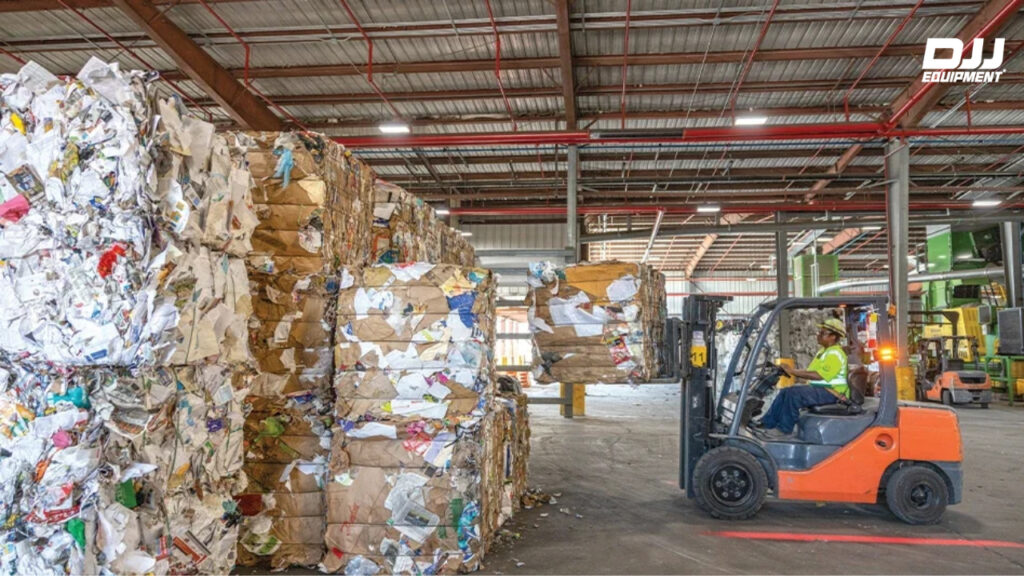
The right forklift for a recycling or waste yard is built for the ground, the debris and the load you actually lift, not for a clean warehouse floor. An outdoor yard usually suits a rough terrain forklift or a heavy counterbalance truck on tough tyres, with the hydraulics to run a bale clamp. An engine truck needs dust protection for its radiator, while a lithium model has no engine radiator to clog. Indoor sorting halls on sealed concrete can run a standard electric counterbalance forklift, or an LPG one where the building is well ventilated. Whichever you choose, size it for your heaviest load with the attachment fitted, because a clamp takes capacity off the rated figure.
Why recycling yards are hard on forklifts
A warehouse forklift is designed around smooth concrete and a pallet with its weight in the middle. A recycling yard breaks both of those assumptions. The ground is often broken concrete, gravel or mud, littered with baling wire, scrap metal, glass and timber splinters. The loads are bales, bins, drums and loose material, and a wet bale weighs more than a dry one.
Debris is the other problem. On an engine forklift, the cooling fan pulls air through the radiator, and in a paper, plastic or timber yard that air is full of lint, film and dust. The radiator clogs and the engine runs hot. Wire and plastic strapping wrap around the drive axle, and litter that builds up near a hot exhaust can catch fire. SafeWork NSW lists cardboard piles among the fire risks on waste sites, including combustion from contact with moving plant.
Mud, water and leachate add wear on brakes and corrosion on electrics, especially where machines are hosed down often. None of this means a forklift can't work in a waste yard. It means the specification has to start from the site, not from the headline capacity.
Which forklift suits which recycling yard?
A yard that handles baled and loose material usually needs a forklift for bales and bins and a second machine for loose material. Which forklift fits depends on the surface. The table matches four common yard types with the machine that usually fits and the first thing to check.
| Yard | Typical loads | Machine that usually fits | Check first |
|---|---|---|---|
| Indoor sorting hall or baling shed on sealed concrete | Bales, bins, pallets | Counterbalance forklift | Electric, or LPG with good ventilation; clamp hydraulics and a place to charge or swap cylinders |
| Outdoor paper, plastic or timber yard | Bales, bins, loose timber | Rough terrain or heavy counterbalance forklift | Dust protection for the engine and radiator |
| Scrap metal or demolition recycling yard | Heavy bales, bundles, bins of scrap | Heavy counterbalance or rough terrain forklift | Puncture-proof tyres and a cab |
| Transfer station with stockpiles or open-top bins | Loose waste and bulk material | Telehandler or wheel loader | Reach over bin walls and separation from people |
Loose waste, soil and green waste are bucket work, and forks aren't the right tool for pushing piles, so pair a rough terrain forklift with a wheel loader or telehandler for that work.
A wheel loader moves and loads loose material. A telehandler reaches forward as well as up, so it can stack higher and place loads over the wall of an open-top bin, which a forklift mast can't do.
Rough terrain or heavy counterbalance forklift?
A recycling yard's ground decides between the two. If the forklift spends much of its shift on gravel, mud or broken concrete, it needs the clearance, tyres and drive of a rough terrain machine. If the yard is mostly sealed, a heavy counterbalance truck on pneumatic tyres usually does the same job in less space.
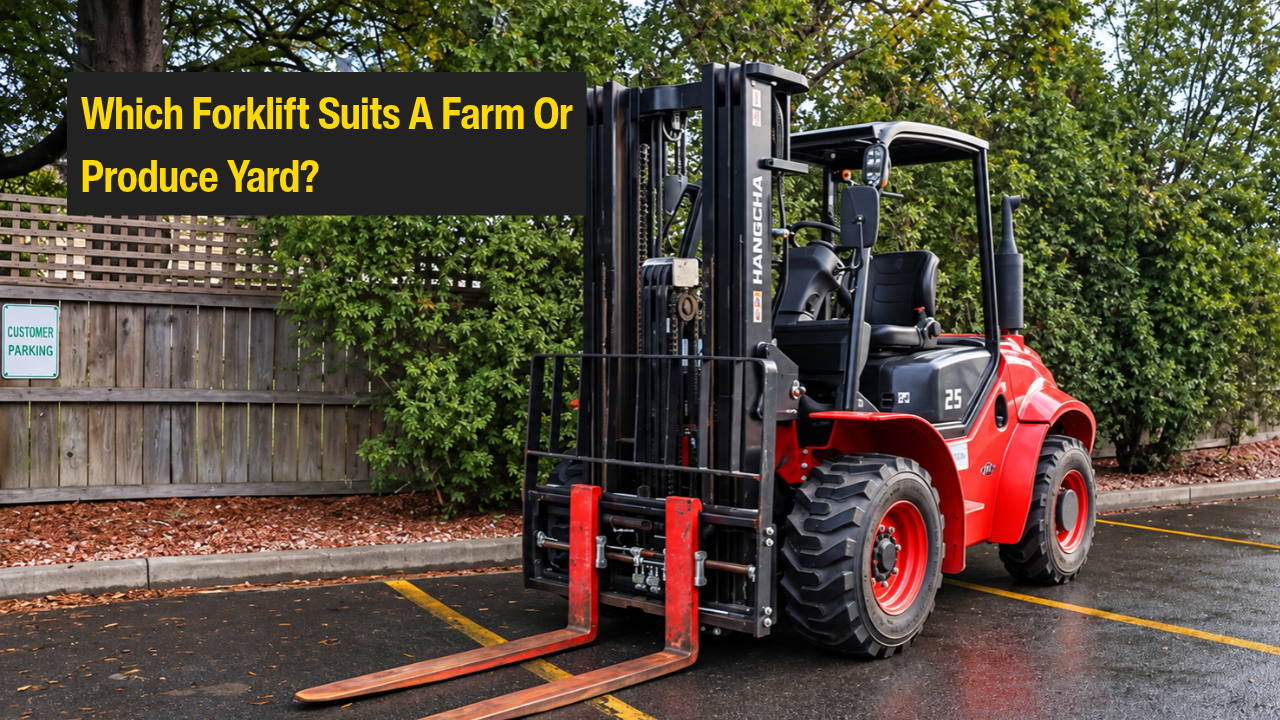
At the heavy end, the Hangcha 5-10 t rough terrain forklift lifts 5,000, 7,000 or 10,000 kg at a 600 mm load centre. Every model has wet brakes, dual air filters and a high-position exhaust, which all help in a dusty yard, and a cab, solid tyres and extra hydraulic valves for attachments are options.
Check the turning space before you commit. On that range, the 7 tonne 4WD model turns in 5,290 mm against 3,960 mm for the 2WD version, and every extra metre counts between stockpiles, bays and baling lines.
On sealed yards, the XF2 Series 4-5.5 t is a diesel or LPG counterbalance forklift with a maintenance-free wet-brake drive axle. Its overhead guard has pre-set holes for conversion to a cab, and it's rated at a 500 mm load centre, with 2,100-2,650 kg still available at a 7 m lift on dual tyres.
Forklift tyres for scrap, glass and rough ground
Tyres are where recycling yards differ most from other outdoor sites. Air-filled pneumatic tyres ride well on rough ground, but scrap metal, wire and broken glass puncture them, and a flat tyre stops the machine.
Solid tyres can't go flat, but they ride harder and pass more shock into the truck and the operator. On long runs with heavy loads, solid rubber also builds up heat inside the tyre, which wears it faster. Foam-filled pneumatic tyres sit in between: the casing is filled so it can't deflate, but it keeps a tyre shape that copes with ruts. Press-on cushion tyres suit smooth sealed floors only.
Choose tyres by the route each machine drives, not one tyre for the whole fleet. A truck shuttling bales across sealed concrete and a truck working a gravel stockpile area need different tyres. Solid tyres are an option on the Hangcha 5-10 t and high-voltage lithium rough terrain forklifts, and whichever tyre you run, check the tread at every pre-start, because a worn solid tyre loses grip on wet ground.
How much capacity do forklift clamps and attachments take away?
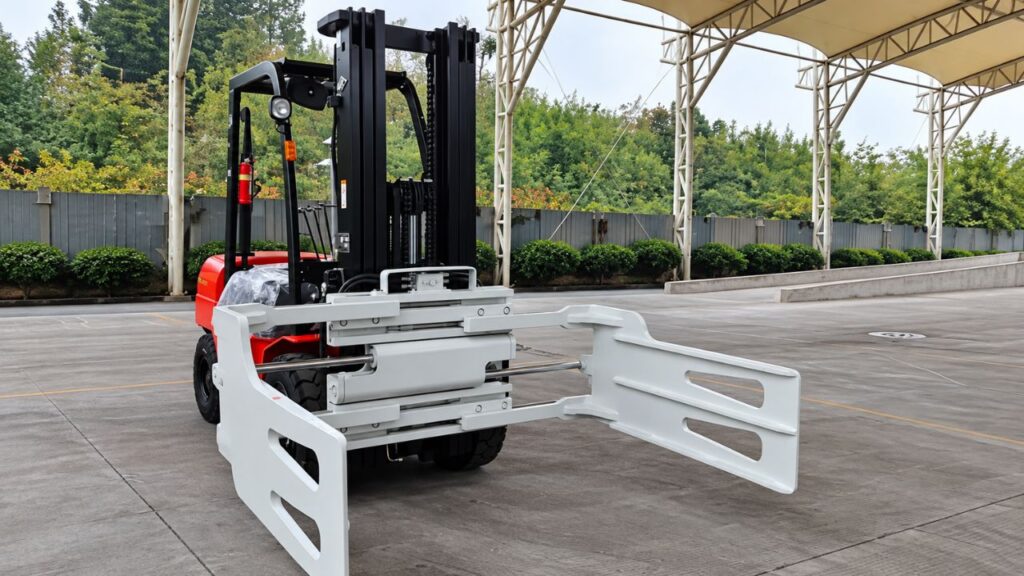
A recycling forklift often loses hundreds of kilograms of capacity to its attachment, and much of the work is done with one: bale clamps for paper, cardboard and plastic, rotating clamps for tipping bins, drum clamps and grapples for scrap.
Every attachment costs capacity. It adds its own weight at the front of the truck and moves the load further forward, so the forklift can lift less than its rated figure. Even a sideshifter makes a difference. The Hangcha high-voltage lithium rough terrain forklift loses 200 kg of rated capacity with an integral sideshifter and 300 kg with an external one, and a bale clamp is heavier and longer than either.
Bale size matters too. The rating assumes the load's centre sits 500 or 600 mm from the fork face, depending on the truck. A bale 1,200 mm deep has its centre about 600 mm out, and two bales clamped end to end push it further. Before you choose a capacity:
- weigh your heaviest bale or bin, wet as well as dry
- check the attachment is compatible and the truck has the extra hydraulic valves it needs
- make sure the data plate and load chart cover the attachment before it goes to work
- size the forklift on the capacity with the attachment fitted, not the bare rating
DJJ Equipment supplies forklift clamps and rotators for this work.
Electric, LPG or diesel in a waste yard?
Diesel has long been the default in outdoor waste yards, and it still suits heavy, all-day work far from a power supply. LPG suits sites where the same truck moves between well-ventilated sheds and the yard. Keep diesel forklifts out of enclosed buildings, where exhaust builds up. Electric forklifts have no exhaust heat near litter and no engine radiator for dust to clog.
Battery machines now work outdoors on rough ground as well. The Hangcha high-voltage lithium rough terrain forklift lifts 2,500, 3,000 or 3,500 kg at a 500 mm load centre on pneumatic tyres, with 225-290 mm of ground clearance and a differential lock as standard. Its 46.4 kWh battery charges fully in about 1.5 hours, and a cab, a reversing camera and solid tyres are optional.
The trade-off is charging. You need a charging point close to the work and a shift pattern that leaves time to charge. Lithium usually costs more to buy than an engine forklift, and the saving comes back through lower energy and servicing costs, so it makes most sense on machines that run long hours.
For heavier loads, the XE Series 6-10 t puts a 96V lithium battery into an IC truck frame with IC axles and large pneumatic tyres, so it suits outdoor yards where an engine forklift would normally work. It's rated at a 600 mm load centre with IPX4 protection and dual-gun fast charging, and its battery carries a 6-year or 12,000-hour warranty.
Dust, fire and debris on recycling forklifts
Whatever the power source, a waste yard forklift needs more cleaning than a warehouse truck. On engine forklifts, blow out the radiator and engine bay on a schedule set by how dusty the site is, and check the axles and wheels for wire and strapping at every pre-start. Air filters clog faster in dusty yards, which is why dual filters are worth having.
Dust affects the electrics and the operator too. A cab keeps dust and weather off the operator, and on very dusty sites it's worth asking how the cab is sealed and filtered. At Kimbriki Environmental Enterprises, a waste and resource recovery site at Terrey Hills in Sydney that processes about 280,000 tonnes of waste a year, dust affected the seat harness connection on its lithium rough terrain forklift. DJJ fitted a dedicated connection socket at no charge, and it's the kind of fault worth raising early, before it becomes a safety problem.
Fire needs heat and fuel together: a hot exhaust or turbo with paper dust, plastic film or leaking hydraulic oil around it. Keep the engine bay clean, fix oil leaks quickly and don't park a hot machine against a stockpile. Some sites also fit an automatic fire suppression system to their engine forklifts, and if your site or insurer needs one, raise it before ordering. Lithium-ion batteries thrown out with general waste are a separate hazard, and SafeWork NSW lists them among the materials workers need training to handle.
Keeping people clear of forklifts and plant
Mobile plant and people working in the same space is a serious risk on waste sites. In April 2022, a 51-year-old worker suffered fatal injuries while walking through a waste collection and recycling facility in NSW, struck by a telehandler that was reversing after loading recycled material onto a truck. After the incident, SafeWork NSW told businesses to manage that risk with these controls:
- clearly defined pedestrian-only and vehicle-only areas, with fixed barriers that keep people out of vehicle areas
- bollards, temporary barriers or markings where fixed barriers aren't reasonably practicable
- warning devices such as reversing sensors, reversing cameras, mirrors, rotating lights or reversing alarms
- proximity sensors that detect people and other plant and can sound an alarm or apply the brakes
- a site traffic management plan that workers are trained on and that is followed
- high-visibility clothing and other protective equipment
Some of these controls belong on the machine, so build them into the specification. A reversing camera, rotating light and reversing alarm are simpler to order with a forklift or telehandler than to retrofit. SafeWork NSW also expects daily checks of each vehicle before use. Each operator also needs the right licence or training for the machine: class LF for a forklift, and machine-specific training for a telehandler used with forks or a bucket.
Tell the DJJ team what you handle, what your heaviest bale or bin weighs when wet, which attachment you need, what the yard surface is and how many hours a day the truck will run. They can recommend a machine and attachment for the site, to buy or hire. Call 1800 355 388 or send an enquiry to your nearest branch.