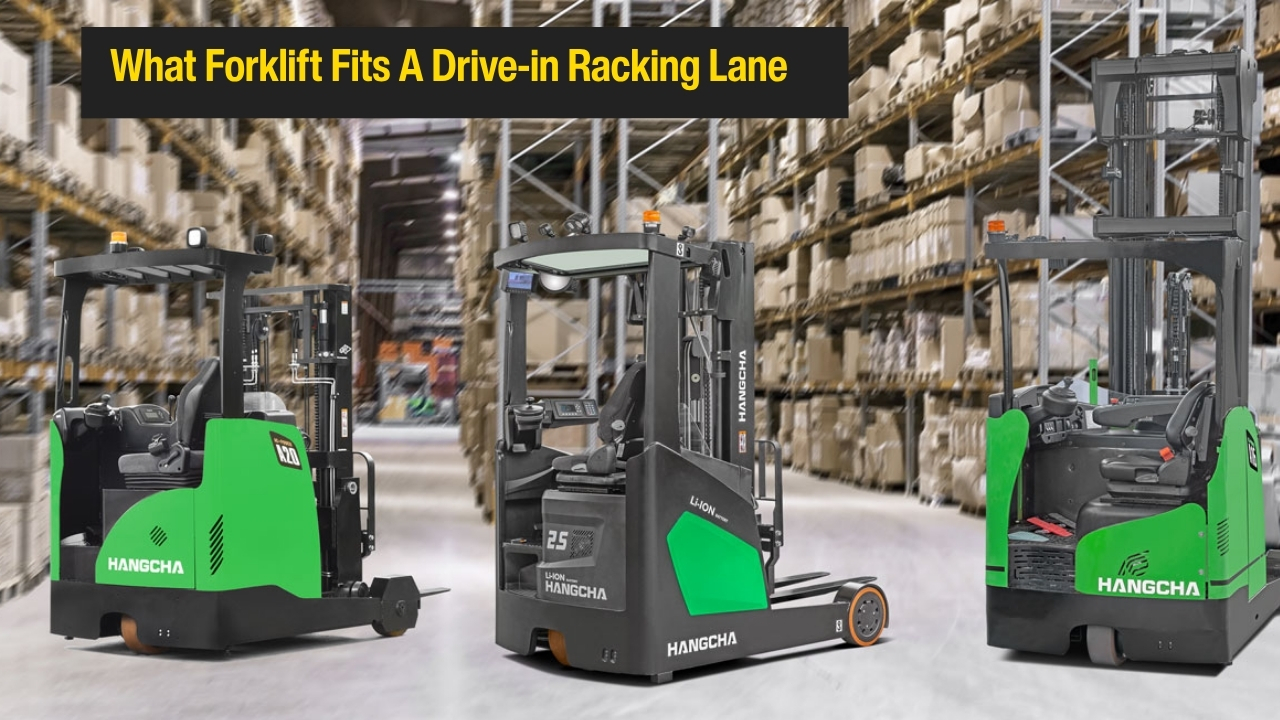
The right forklift fleet for freight and cross-dock work is built for speed across the floor, not height. In a freight depot, pallets come off one truck and go onto another within hours, so the driving happens inside trailers, over dock plates and across the staging floor. In practice that means electric pallet jacks or riders for the horizontal runs, counterbalance forklifts for the dock face and trailer loading, and a reach truck only where there is racking, kept off the trucks. Size the fleet by your busiest hour and the number of doors working at once, not by the size of the building.
Why freight and cross-dock depots need different forklifts
Freight and cross-dock depots need different forklifts because they are built around time rather than storage. Freight arrives at one set of doors, is sorted on the floor and leaves through another set, often on the same shift, while a storage warehouse is built around racking and height.
That changes what the forklifts do all day. They drive in and out of trailers, cross dock plates hundreds of times, change direction constantly and stop again and again for the operator to scan labels or check counts. Freight is mixed, with pallets of different sizes, overhanging loads and the odd long item.
Buying one type of forklift for every job is a costly shortcut. A sit-down counterbalance truck can do most dock work, but it costs more and takes more room than a pallet truck for pure floor-to-floor runs, and it isn't the best tool for stacking high in racking.
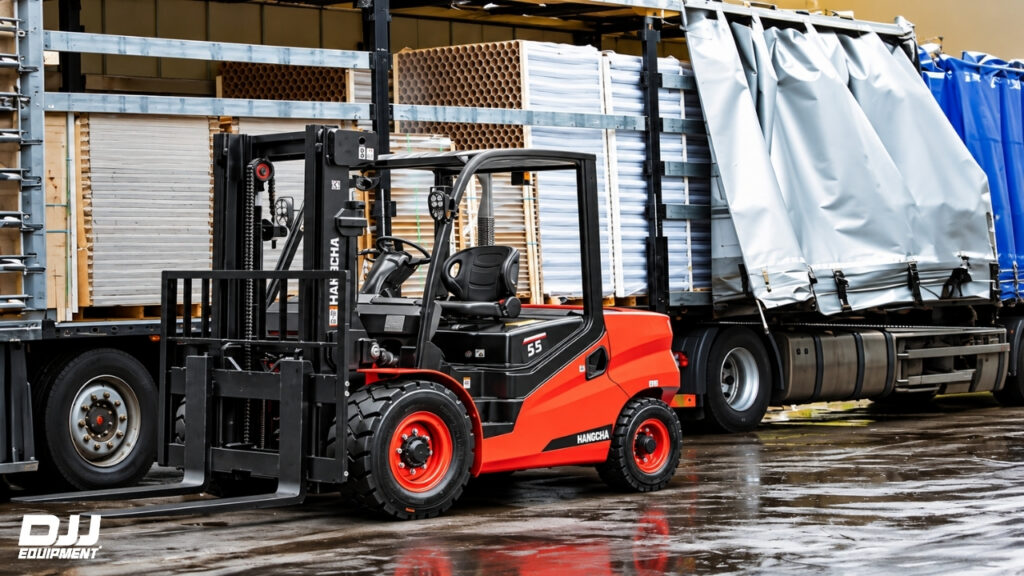
Match each forklift to its job on the dock
Dock work usually splits into four jobs, each suited to a different machine. A depot that does all four needs a mix of forklifts and pallet trucks rather than one type.
| Job | Machine that usually fits | Hangcha example | Watch for |
|---|---|---|---|
| Short pallet runs from trailer to staging lane | Electric walkie pallet jack | A Series walkie 2.7-3.6 t: 6 km/h laden | Walking pace limits long runs |
| Longer runs between inbound and outbound doors | Stand-on rider pallet truck | A Series end-control rider 2.7-3.6 t: 9 km/h laden | Ramps and dock plate gradients |
| Double stacking in trailers and loading trucks | Stand-up or sit-down counterbalance forklift | A Series stand-up 1.5-2.3 t: 1,360-2,270 kg | Lowered mast height and free lift |
| Short-term buffer racking | Reach truck | A Series reach truck 2-2.5 t: aisle from 2,745 mm | Keep it on smooth floors and out of trailers |
Reach trucks belong in the racking, not on the dock: their small, hard load wheels and outrigger legs aren't built for dock plates or trailer floors, so they hand pallets over at floor level to a counterbalance truck or pallet jack.
Pallet jacks and riders for the horizontal runs
When a pallet only needs to move across the floor, a pallet truck does it with less cost and less space than a masted forklift. Walkie pallet trucks suit short runs and tight staging lanes, while ride-on pallet trucks suit the longer distances between doors.
The A Series walkie pallet truck 2.7-3.6 t carries 2,700 or 3,600 kg at a 610 mm load centre, travels at 6 km/h laden and runs on a 25.6V lithium battery. Forks up to 3,658 mm long let it carry several pallets at once, and anti-rollback holds it on ramps.
The ride-on version moves faster. The A Series end-control rider pallet truck travels at 9 km/h laden and 14 km/h unladen, is 910 mm wide and turns in 2,035 mm. Its 2,438 mm or 3,658 mm forks carry two or three pallets at once, and a parking brake and anti-slide function stop it rolling on a grade.
A stacker with initial lift also carries two pallets in one trip. Its support arms lift slightly as well as the mast, so one pallet rides on the arms and a second on the forks above.
The Hangcha X Series initial-lift pallet stacker takes up to 2,000 kg on initial lift and 1,200-1,600 kg on the mast. The stand-on version travels at 9 km/h laden for longer runs.
Stand-up or sit-down counterbalance forklift at the dock face?
A stand-up counterbalance forklift suits short, busy runs between the dock and the staging lanes. The operator stands side-on, so they look both ways without twisting when they back out of a trailer, and step on and off quickly to scan or check freight.
The A Series stand-up 3-wheel forklift lifts about 1,360-2,270 kg at a 600 mm load centre and turns in 1,367-1,585 mm. It travels at up to 12.4 km/h laden and slows automatically in corners, and its 36V lithium battery charges fully in 2 hours. It runs on cushion tyres, so keep it on sealed floors and sound dock plates.
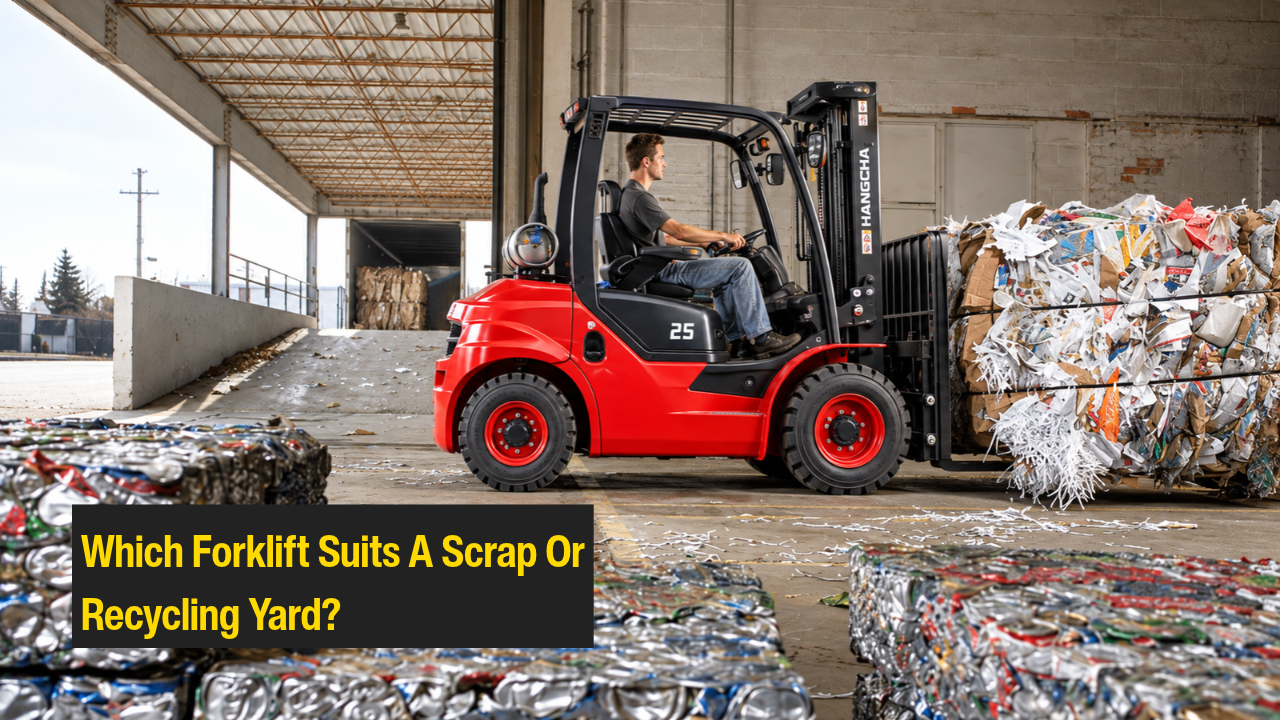
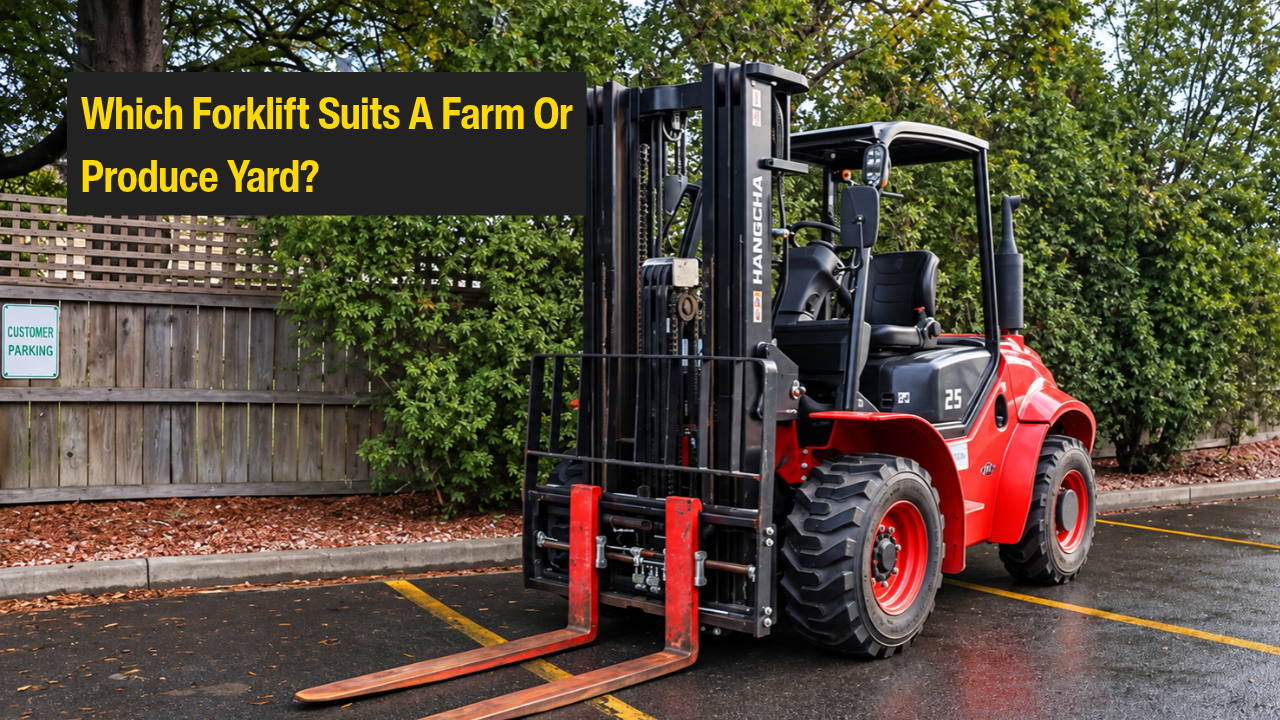
A sit-down 4-wheel counterbalance forklift is the better choice for heavier freight, longer runs, outdoor yards and steeper dock ramps, and for heavy attachments. A depot with both kinds of work can run stand-up trucks at the doors and sit-down trucks for heavy freight and the yard.
Which forklift mast and attachments suit trailer work?
Every forklift that works inside trailers needs a lowered mast height that clears the trailer or container door, plus enough free lift to raise a pallet for double stacking before the mast extends upwards. The door header is usually the limit, and the door height and free lift checks used when choosing a container forklift apply to vans and enclosed trailers too.
Hangcha builds low-mast versions for this work. The container models of the X Series 6-10 t electric forklift have a 2,185-2,200 mm lowered height, and the 3.5-3.8 tonne models of the XE Series 1.5-3.8 t can take a 4.5 m container mast.
Attachments speed up mixed freight. A sideshifter lines a pallet up against the trailer wall without repositioning the truck, and a fork positioner adjusts the forks for narrow and wide pallets from the seat. Both add weight at the front and reduce capacity, so check the load chart with the attachment fitted. DJJ Equipment supplies sideshifters and fork positioners. Before ordering, confirm the attachment is compatible with the truck it will go on.
Electric, LPG or diesel on a freight dock?
Inside trailers and enclosed depots, electric forklifts keep exhaust away from drivers and dock staff. The carbon monoxide that LPG and diesel trucks give off has a tighter limit from 1 December 2026, when Safe Work Australia's workplace exposure limit drops to 20 ppm over an 8-hour shift, from 30 ppm. An LPG truck can still work an open, well-ventilated dock, and diesel is better kept to heavy freight in the outdoor yard.
Charging also favours lithium on a busy dock. A lithium battery can be topped up during breaks, so the truck doesn't need a battery change mid-shift or a separate charging room taking up floor space that could hold freight.
How many forklifts does a freight dock need?
There is no reliable rule based on floor area, because a small, busy depot can need more machines than a large, quiet one. Work it out from your own freight instead:
- Count pallet moves per day and in the busiest hour. A pallet unloaded to a staging lane and later loaded onto another truck counts as two moves.
- Time a full cycle for each job on your own floor, including travel, lifting, placing and waiting at intersections.
- Work out how many trailers must be emptied or loaded at the same time, and how long the trucks can wait.
- Calculate each job separately: pallet runs, trailer work and racking.
- Add a spare machine for servicing and breakdowns.
For example, if your busiest hour has 120 pallet moves and your own timing shows one rider pallet truck manages 30 moves an hour on that run, you need four for that job before any spare. Those figures are examples only; your own counts and timings are what matter.
A common approach is to own the machines you need all year and hire extra for peaks such as the run-up to Christmas. Forklift hire can cover a peak with pallet jacks, pallet stackers, reach trucks or forklifts on selected models; minimum hire terms depend on the machine and branch.
Loading dock safety for forklift fleets
Loading dock safety starts with the truck at the dock. WorkSafe WA says to make sure a truck is correctly in position before a forklift goes onto the dock area. A trailer that moves while a forklift drives in and out opens a gap at the dock plate, so secure it before loading starts.
The dock edge is where forklifts go over. Loading docks are typically about 1.2 metres above the ground, and WorkSafe WA says physical barriers or other appropriate systems are needed wherever a wheel could be driven over the edge.
WorkSafe WA's risk questions are a useful checklist for a busy depot:
- is the dock surface smooth, or slippery when wet?
- is the dock congested with goods and other forklifts?
- do pedestrians use the area, and how are they kept apart from forklifts?
- is there a dock leveller, and how is it operated?
Check gradients too. Dock levellers and ramps are often steeper than the floor, so choose machines with enough laden gradeability. The A Series walkie pallet truck, for example, climbs 10% laden at 2,700 kg and 8% at 3,600 kg.
Tell the DJJ team your pallet numbers on a peak day, how many doors you run, how far freight travels, what trailers you load and whether you have racking. They can put together a mix of machines for the dock, to buy or hire. Call 1800 355 388 or send an enquiry to your nearest branch.