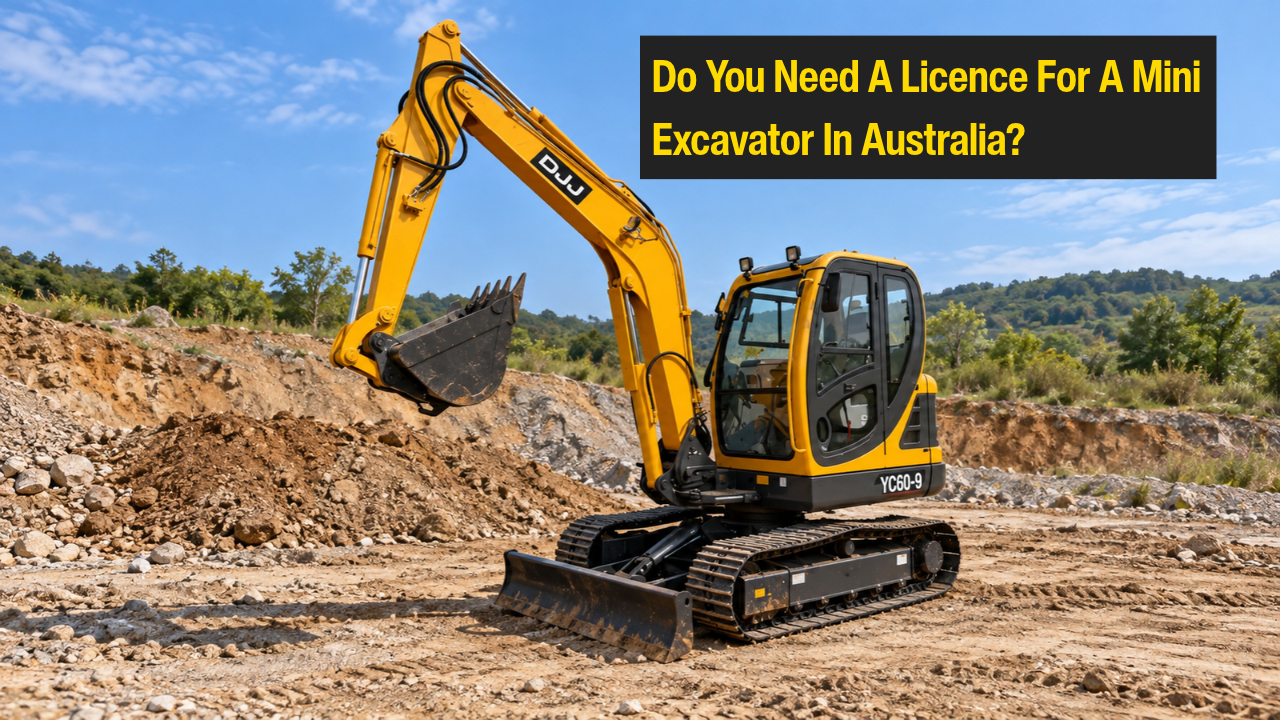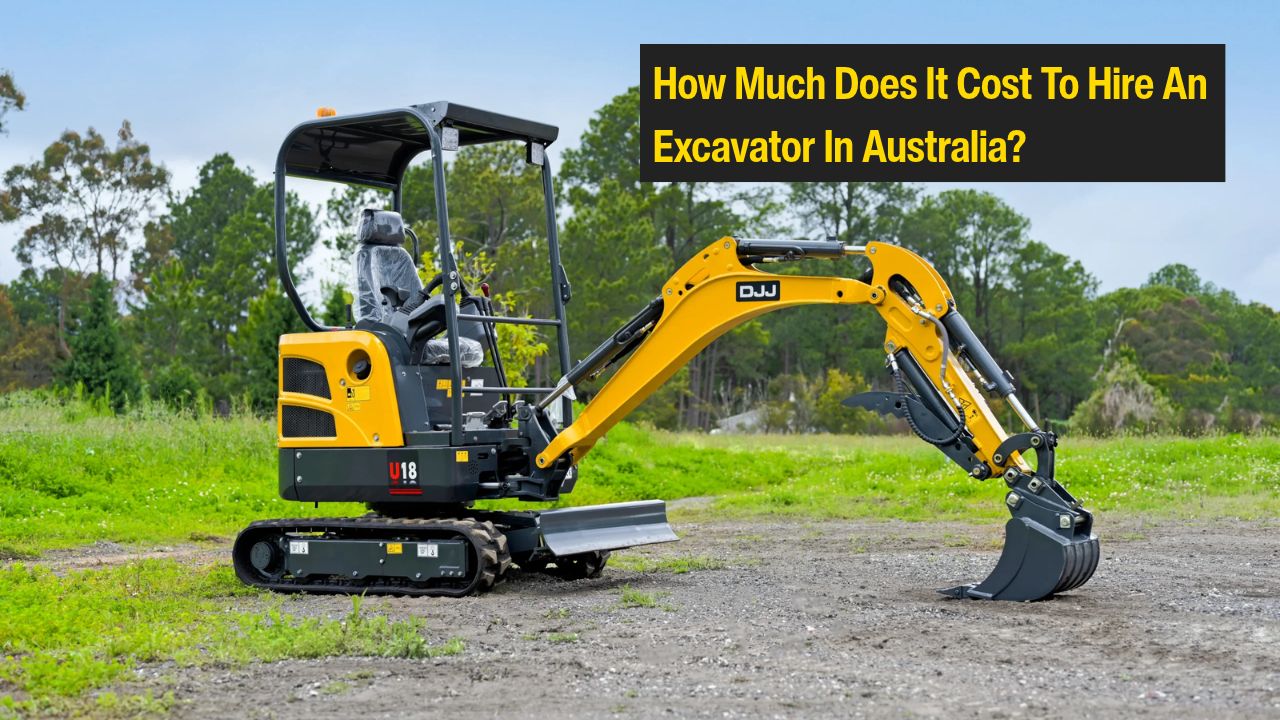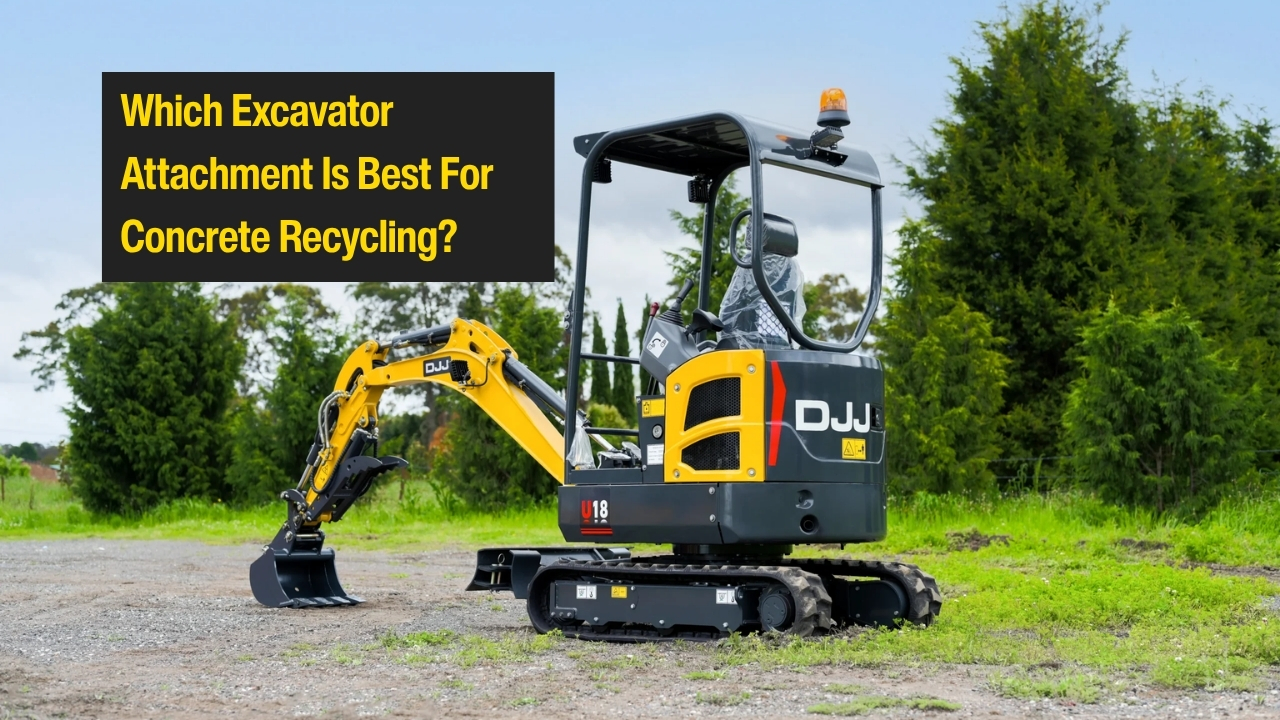
The main types of excavator buckets are general purpose, trenching and mud buckets for everyday work, plus tilt, rock, skeleton and V-ditch buckets for particular jobs. They differ in the cutting edge, the width and the thickness of the steel. Most mini excavators work with two or three of them. The YC60 excavator from DJJ Equipment comes with a 300 mm trench bucket, a 450 mm general purpose bucket and a 900 mm mud bucket on a mechanical quick hitch.
What are the main types of excavator buckets?
Each excavator bucket type is built for either cutting into ground or finishing a surface. A toothed edge cuts, a smooth edge levels, and the width decides how much force reaches each part of the edge. The table sets out the common types and what each one needs from the machine.
| Bucket type | Cutting edge | Main job | Extra hydraulics |
|---|---|---|---|
| General purpose (digging) | Teeth | Footings, bulk digging, loading trucks | None |
| Trenching | Teeth, narrow shell | Pipe, cable and drainage trenches | None |
| Mud, batter or trimming | Smooth, wide | Levelling, backfilling, clean-up | None |
| Tilt | Smooth, wide | Batters, swales and drains at an angle | Two-way auxiliary circuit |
| Rock or heavy duty | Heavy teeth, side cutters | Rock, shale, gravel and other abrasive ground | None |
| Skeleton or riddle | Open grid of tines | Sorting rocks, roots and rubble from soil | None |
| V-ditch | V-shaped shell | Drains cut to a set profile in one pass | None |
Only the tilt bucket needs extra hydraulics, because a pair of rams inside it does the tilting. The rest are fixed shells, and the machine's bucket cylinder does all the work. That makes general purpose, trenching and mud buckets the usual starting set on a new excavator.
Why does a general purpose bucket stay on most excavators?
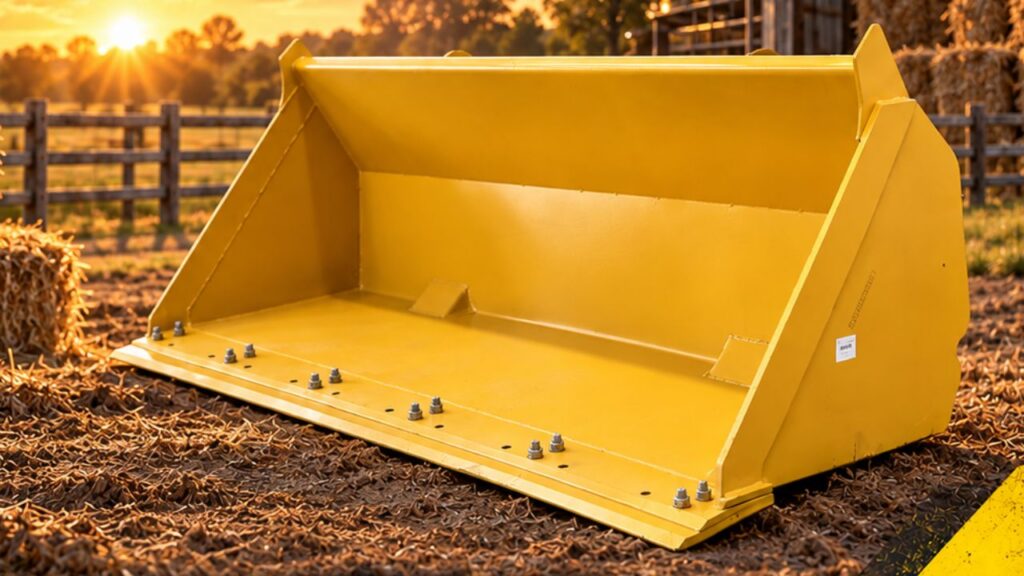
A general purpose bucket stays on because it can dig, carry and load in one tool. Its curved shell fills in one curl and empties cleanly. Its teeth focus the bucket force on a few points, so it bites into firm clay and gravel that a smooth edge would skid across.
On a 1 tonne machine the standard bucket is small. The YC10 bucket is 356 mm wide and holds 0.02 m³. On the 1.8 t U18 it grows to 470 mm and 0.05 m³. The YC60 carries a 450 mm general purpose bucket in its standard set, alongside the trench and mud buckets.
A general purpose bucket is the right excavator bucket for house footings, pool digs, stump holes and loading a truck from a stockpile. It is the wrong one for a cable trench, where it digs out more soil than the job needs.
What does a trenching bucket do that a wider excavator bucket can't?
A trenching bucket digs a trench the width of the pipe or cable and no wider. Less soil comes out, so there is less to backfill and compact afterwards. On a long service run, that saving adds up over every metre.
A narrow bucket also digs harder ground. The bucket digging force is the same whatever bucket is on the arm, so a narrower edge puts more of it on each millimetre. The U18 has 15.5 kN of bucket digging force. On its 470 mm bucket that force spreads along 470 mm of edge. On a 300 mm trench bucket the same force sits on about a third less edge, so it pushes into compacted ground more easily.
The YC60 trench bucket is 300 mm wide, which suits stormwater, irrigation and electrical conduit. Before any trench goes in, contact Before You Dig Australia to find where electrical cables and other buried services run.
When is a mud or tilt bucket the right excavator bucket?
A mud bucket is the right excavator bucket when the ground is already loose and the job is shaping it. It is wide, lighter for its size and has a smooth edge, so it leaves a clean, flat surface instead of tooth marks. Australian suppliers also call it a batter bucket or trimming bucket.
The width that makes it fast on finishing work makes it slow on digging. The YC60 mud bucket is 900 mm wide, twice the width of its 450 mm general purpose bucket. With the same 36.6 kN of bucket force spread across twice the edge, each part of it pushes with half the force. Use it for backfill, levelling pads and driveways, cleaning out drains and final trim around slabs, and swap back to the toothed bucket when the ground gets hard.
A tilt bucket works like a mud bucket on a pivot, swinging to either side on its own rams. The operator can cut a batter or a swale at an angle without moving the tracks for every pass. It needs a two-way auxiliary circuit with enough flow to run it. On a 1 t machine a tilt bucket is a big piece of steel for the arm to carry, so on the smallest excavators a fixed mud bucket and a few extra repositioning moves is often the better trade.
How are rock and heavy duty excavator buckets built differently?
Rock and heavy duty excavator buckets use thicker plate and wear-resistant steel, with side cutters, wear strips under the shell and heavier teeth. Many have a narrower, pointed lip that concentrates the digging force on the centre teeth. They last far longer than a general purpose bucket in shale, gravel, ironstone and broken rock.
The cost is weight. A heavy duty bucket can weigh much more than a general purpose bucket of the same width, and every extra kilogram of steel is a kilogram less material the machine can lift and carry on each pass. That matters most on mini excavators, where the margins are small.
Bucket digging force sets the limit. It is 8.38 kN on the 1 t E12 and YC10, 15.5 kN on the U18 and 36.6 kN on the YC60. A rock bucket helps a 5.7 t machine in weathered rock, but a 1 t machine in hard ground does better with a ripper tooth or a small hydraulic hammer first, two of the other types of excavator attachments, then a general purpose bucket to clear the broken material. Skeleton and V-ditch buckets are special shapes rather than duty classes, and most owners add one for a particular job.
How is excavator bucket capacity measured?
Excavator bucket capacity is measured as heaped volume: the volume level with the rim, called struck volume, plus a heap of material piled on top. It is quoted in cubic metres. That figure is the volume the bucket can carry, not the weight.
The figure helps most when it is turned into passes. To move one cubic metre of loose soil, a 0.02 m³ bucket on the YC10 or E12 takes about 50 full passes. The 0.05 m³ bucket on the U18 takes about 20. The 0.21 m³ YC60 bucket takes about 5. Those are full, heaped buckets. Wet clay that sticks to the shell and rock that leaves gaps between pieces both fill a bucket less than its rating, so real jobs take more passes.
Dug soil also takes up more room than it did in the ground, because breaking it up opens gaps between the particles. A hole that measures one cubic metre produces more than one cubic metre of loose spoil, so plan truck loads and stockpile space on the loose volume, not the size of the hole.
What size excavator bucket suits a 1 t, 1.8 t and 5.7 t machine?
The right excavator bucket size is the one the machine fills easily in your ground. A bucket that's too wide spreads the digging force thin and slows every pass in clay. A bucket that's too heavy adds weight at the far end of the arm, which eats into the machine's stability when it slews side on with a full load. The table lists the standard bucket and digging force on each excavator in the DJJ range.
| Model | Operating weight | Standard bucket capacity | Bucket digging force | Max digging depth |
|---|---|---|---|---|
| E12 | 1,000 kg | 0.02 m³ | 8.38 kN | 1,475 mm |
| YC10 | 1,000 kg | 0.02 m³ (356 mm wide) | 8.38 kN | 1,435 mm |
| U18 | 1,880 kg | 0.05 m³ (470 mm wide) | 15.5 kN | 2,295 mm |
| YC60 | 5,700 kg | 0.21 m³ | 36.6 kN | 3,720 mm |
The table shows the jump between classes. The YC60 holds about ten times the volume of the 1 t buckets and has more than four times the bucket force. On the 1 t machines, a narrow trenching bucket and a general purpose bucket cover most work, because there is little force to spare for a wide shell. From the U18 upward, a mud bucket for finishing earns its place, and the YC60 ships with all three.
Hitch type matters as much as size. The YC10 and U18 come with a half hitch, and the YC60 with a mechanical quick hitch. On the E12, one of the compact excavators we sell, three auxiliary lines come preset for a hammer and rotation, fed by a 24 L/min pump, which is the supply a powered attachment draws on.
What should you check before fitting a bucket to an excavator?
Before fitting a bucket to an excavator, check that it matches the machine and the hitch on four points:
- Pin diameter: the bucket pins must match the hitch or the arm.
- Pin centres: the distance between the two pins must match, even when the diameter does.
- Ear width: the gap between the bucket ears must suit the hitch or the end of the arm.
- Weight: the bucket plus a full load must suit the machine's size.
Two buckets with the same pin size can still have different pin centres, and a hitch that doesn't fully engage the pins can let a bucket fall. Safe Work Australia notes in its quick hitch information sheet that attachments coming off hitches without warning have killed people in Australia. Its list of checks starts with making sure the attachment suits the hitch and the hitch suits the machine. On a half hitch or mechanical hitch, the operator has to get off the machine at every bucket change to engage the safety system by hand.
Wear parts need checking too. Teeth, adaptors and the cutting edge take the wear first, and most of them bolt or pin on, so they can be changed while the shell stays in service. Change the teeth before they wear down into the adaptor, because a worn adaptor no longer holds a new tooth tightly. A bolt-on smooth edge that fits over the teeth turns a general purpose bucket into a clean-up bucket for finishing work.
Getting the right excavator buckets with your machine
We supply buckets, hydraulic breakers and augers for the excavators we sell. Tell our team which model you run or plan to buy, what ground you dig most and the jobs you take on, and we'll match the buckets to the machine. Call 1800 355 388.