The right forklifts for manufacturing depend on what each part of the plant does, so a plant with docks, racking and a production line usually needs more than one type. Receiving docks and truck loading suit a counterbalance forklift, high storage racking suits a reach truck, and feeding the production line often suits a tow tractor or a pallet truck rather than a forklift. In each area, the heaviest load, the narrowest aisle or door and the number of shifts decide which machine fits. Where people work all day in an enclosed building, electric forklifts are the safer choice, because engine exhaust builds up indoors.
Map the forklift to each part of the plant
A factory is really several sites under one roof, and each one asks something different of a forklift. Each area may need a different machine, from forklifts to tow tractors and pallet trucks. The table matches each plant area with its main job, the machine that usually fits, its power source and what to check first.
| Plant area | Main job | Machine that usually fits | Power | Check first |
|---|---|---|---|---|
| Receiving and dispatch docks | Unloading and loading trucks | Counterbalance forklift | Electric, or LPG where the dock is well ventilated | Mast height for trailers and dock ramps |
| Raw material and finished goods racking | Storing pallets high | Reach truck | Electric | Smooth, level floor and top beam height |
| Production line feeding | Delivering parts and taking away finished work | Tow tractor with trolleys, or pallet truck | Electric | Route width and pedestrian traffic |
| Outdoor yard and heavy raw materials | Steel, castings, bulk bags, bins | Counterbalance forklift on pneumatic tyres | Diesel, LPG or heavy-duty electric | Ground surface and heaviest load |
| Areas with flammable gas or dust | Handling in paint, chemical or powder areas | Explosion-proof forklift, such as the XE Series 1-3.5 t | Electric | Zone rating (gas Zones 1-2, dust Zones 21-22) against the site's hazardous area classification |
Running one general counterbalance forklift on every job costs space and time. It needs wide aisles in the racking, it's awkward in busy production areas and it's a slow way to feed a production line.
How do factory loads and attachments change forklift capacity?
Factory loads are often not standard pallets. Dies, long crates, machine parts and bundles of stock can put their weight further from the forks than the rating assumes, and the forklift can then lift less.
The XA Series 2-3.8 t electric forklift shows the effect. Its CPD38 model is rated at 3,800 kg with the load's centre 500 mm from the fork face, but carries about 2.3 tonnes when that centre moves out to 1,100 mm.
Attachments have a similar effect. Clamps, rotators, fork positioners and sideshifters add weight at the front and push the load forward, so the data plate and load chart must cover the attachment before it goes into use. DJJ Equipment supplies these attachments. Confirm that each one suits your forklift and its load chart before you order.
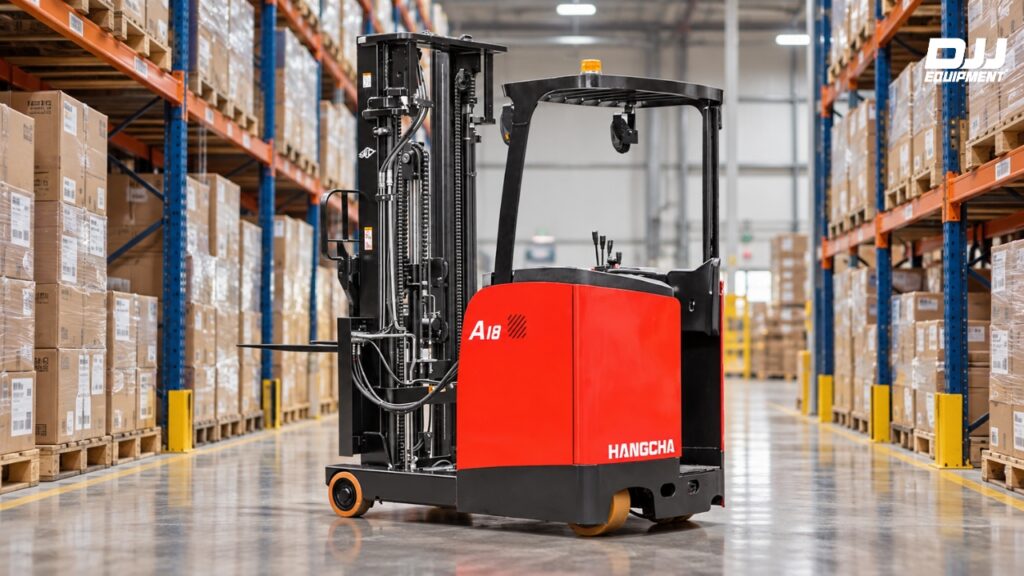
Long stock such as bar, pipe or extrusions has to travel lengthways. A side loader or multidirectional truck does that: the Hangcha X Series 4-way reach truck drives sideways, so a long load fits an aisle not much wider than the truck is long.
Will the forklift fit the factory's aisles, doors, mezzanines and floors?
Aisle width decides which machines fit your racking. A counterbalance forklift needs a stacking aisle much wider than its turning radius, because the truck, the forks and the pallet all have to swing through a right-angle turn.
The XA Series turns in 2,230-2,375 mm, but needs an aisle of about 3,983-4,083 mm to stack a 1000 x 1200 mm pallet carried crossways. A Hangcha reach truck needs a stacking aisle of about 2.6-2.9 m, which is why plants short of floor space move high storage to reach trucks and keep counterbalance forklifts for the docks.
Pallet orientation changes the answer too. Carrying a pallet so its shorter dimension runs along the forks reduces the aisle needed, which can save a racking layout when you move to a larger truck.
Check the height limits as well: low doorways, fire doors, overhead cranes and mezzanine edges. A mast with full free lift raises the forks before the mast extends upwards, which helps under low ceilings. On mezzanines and suspended floors, check the floor rating before any forklift goes up, because most of the weight of the truck and its load sits on the front wheels. The XA Series alone weighs 3,280-4,860 kg before it lifts anything.
Feeding the production line: forklift, pallet truck or tow tractor?
Driving a counterbalance forklift through a busy production area is a poor fit. The mast and load block the view forward, so the operator often has to reverse, and the truck carries only one or two pallets per trip between machines and workers.
One answer is to separate lifting from moving. A tow tractor pulls a train of trolleys from the parts store to the line on a fixed route, so one trip delivers to several stations, and the trolleys stay at floor height where workers can reach them. Tow tractors are compact: the Hangcha X Series tow tractor 3-5 t is a stand-on machine 800 mm wide with a 1,185 mm turning radius, and its QDD30 model tows 3,000 kg at 9 km/h laden. The lifting then happens once, in the store.
For short runs between nearby cells, an electric pallet truck does the job in far less space. The A Series walkie pallet truck 2 t works in a 1,902 mm aisle for a 1000 x 1200 mm pallet crossways, against about 4 m for the XA Series counterbalance forklift.
Electric, LPG or diesel inside a factory?
Enclosed factories suit electric forklifts. LPG and diesel give off carbon monoxide, and under Safe Work Australia's new workplace exposure limits the carbon monoxide limit falls from 30 ppm to 20 ppm averaged over 8 hours from 1 December 2026. Diesel adds particulate, which is why using a diesel forklift indoors is rarely a good idea in a building where people work all day.
LPG can still work in a well-ventilated plant on long shifts, since a cylinder swap takes minutes, and diesel belongs in outdoor yards with heavy loads. For heavy loads outside, there are also electric models built on engine forklift frames, axles and tyres, such as the XE Series 6-10 t, which avoid exhaust where yard and building meet.
Matching forklift batteries and charging to factory shifts
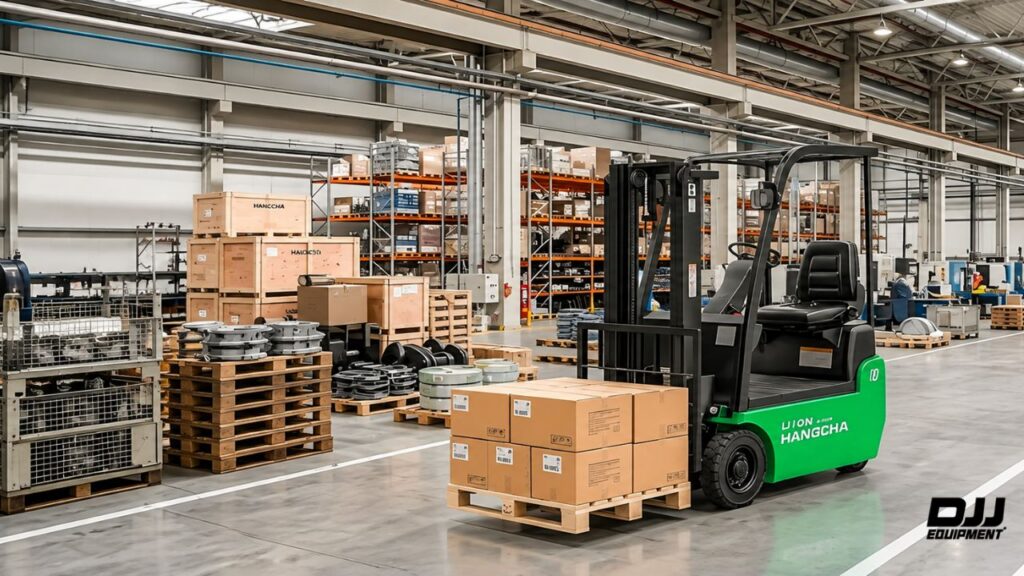
A single-shift plant can run lead-acid or lithium and charge overnight. Two or three shifts favour lithium, because short charges at breaks keep it running without a battery swap between shifts.
Battery size follows the model. On the XA Series 2-3.8 t, the CPD20 and CPD25 carry an 80V/150Ah lithium battery, while the CPD30, CPD35 and CPD38 move up to 80V/230Ah for longer runtime between charges.
Whatever the battery, it is part of the forklift's counterweight. Don't fit a smaller or lighter battery than the truck was designed for, because it changes the truck's stability and rated capacity.
Plan where chargers go before the trucks arrive. Chargers close to break areas make opportunity charging easy, and the electrical supply needs to cover all the chargers that will run at once.
Keeping forklifts and production workers apart
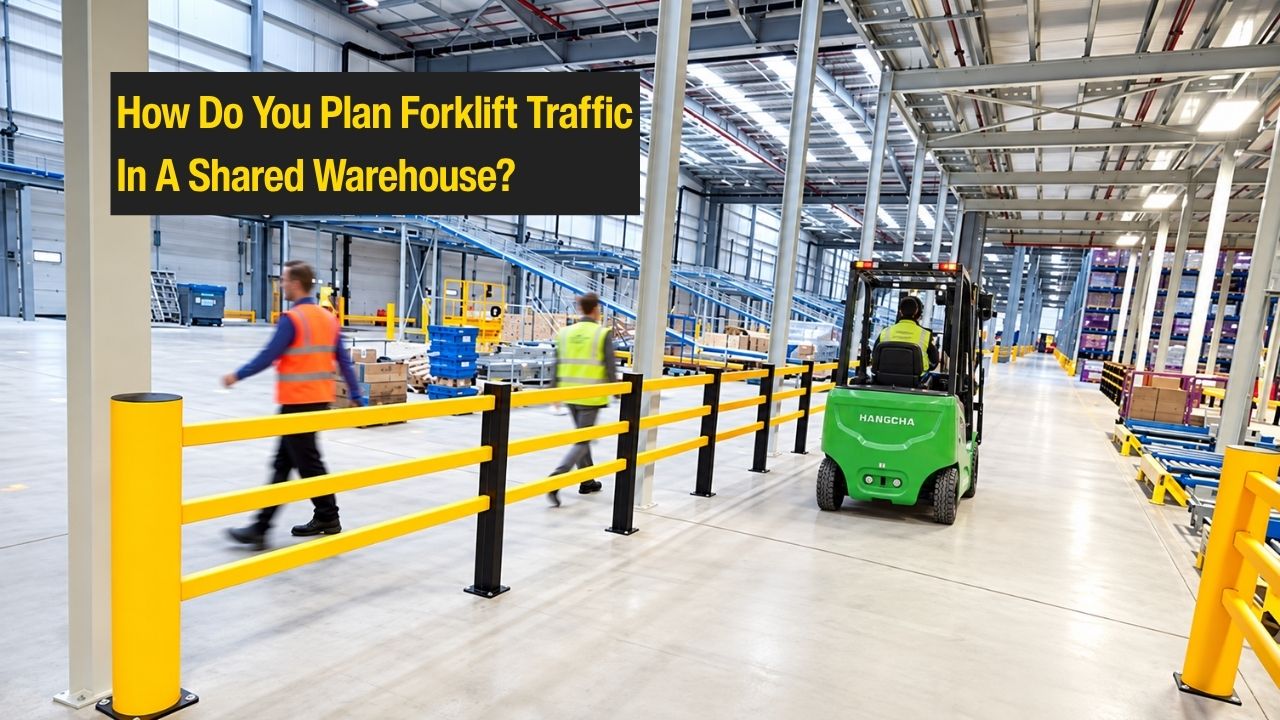
Factories put forklifts, pedestrians and machinery in the same building, often in the same aisle. Separate them where you can with marked walkways, barriers and set routes for forklifts, and add convex mirrors at blind corners and speed limits in busy areas.
Run a pre-start check on every forklift at the start of each day; SafeWork NSW's forklift safety fact sheet lists the horn, lights and reversing beeper among the items to check. Forklift and reach truck operators need a High Risk Work Licence class LF. Operators of order pickers whose controls rise with the load need class LO. Pallet trucks and walkie stackers don't need a high risk work licence, but their operators still need training, as do tow tractor drivers.
Buy, hire or rent to own for a factory fleet?
Machines that work every day usually cost less to buy over their life. Hire suits production peaks, short projects and cover while one of your own trucks is being repaired.
Forklift hire is available on selected electric, LPG and diesel forklifts, reach trucks and pallet stackers, with minimum terms that depend on the machine and branch. Rent to own runs through two current offers, both subject to finance approval: the XA Series 2-3.8 t lithium forklift in Sydney and 2.5 t lithium forklifts in Perth.
Tell the DJJ team your heaviest load and its size, your highest rack beam, your narrowest aisle and doorway, how many shifts you run and whether any area has a gas or dust risk. They can suggest a machine for each part of the plant, to buy or hire, or through a rent-to-own offer where one applies. Call 1800 355 388 or send an enquiry to your nearest branch.