Order picker safety in Australia rests on four things: an LO licence, a platform that stops a fall before it starts, a harness short enough that the operator can't reach the edge, and a tested plan to bring the platform down if the truck stops at height. The truck does part of the work too. The Hangcha A Series high-level order picker slows as its platform rises and won't travel at all once the lift passes 6 m.
What does WHS law require to stop falls from an order picker?
WHS law requires a business to stop a fall from an order picker before it plans for one. Under WHS Regulation 79, work at height that can't be moved to the ground is controlled in a set order. A fall prevention device comes first, then a work positioning system, and a fall arrest system only when neither is reasonably practicable.
On an order picker, the fall prevention device is the platform: its guardrails, gates and enclosed sides. The harness works as a restraint. Safe Work Australia's Code of Practice on managing the risk of falls describes a restraint technique as one that stops a person reaching a position where they could fall.
WorkSafe Victoria's guidance is blunt about the harness. Order picker operators wear a harness and lanyard at all times.
Why an order picker harness must restrain, not arrest
An order picker harness should hold the operator inside the platform, not catch them after they go over the edge. The difference is the length of the line. A lanyard or inertia reel that is too long lets a worker fall and hang below the platform or inside the racking.
A worker hanging from a long line swings like a pendulum. WorkSafe Victoria's sheet on fall restraints on order-picking forklifts warns that the swing can throw the worker into the racking or the mast, with injuries from a serious jolt to fractures. The line can also rub on a sharp corner of the truck or the racking and fail.
Most of WorkSafe Victoria's fixes keep the line short:
- Set the lanyard or reel line so the operator can't fall off the platform.
- Drive the order picker close to the goods, so a short line still reaches the pick.
- Reduce the depth of the racking if picks still need a long reach.
- Fit a personal energy absorber, and consider a wire lanyard, which is harder to cut.
Clip only to the anchor point the maker provides, and select the harness and lanyard to the AS/NZS 1891 series. The A Series narrow aisle high-level order picker 1.3 t can be ordered with a full-body harness as an option.
Order picker safety rules on the raised platform
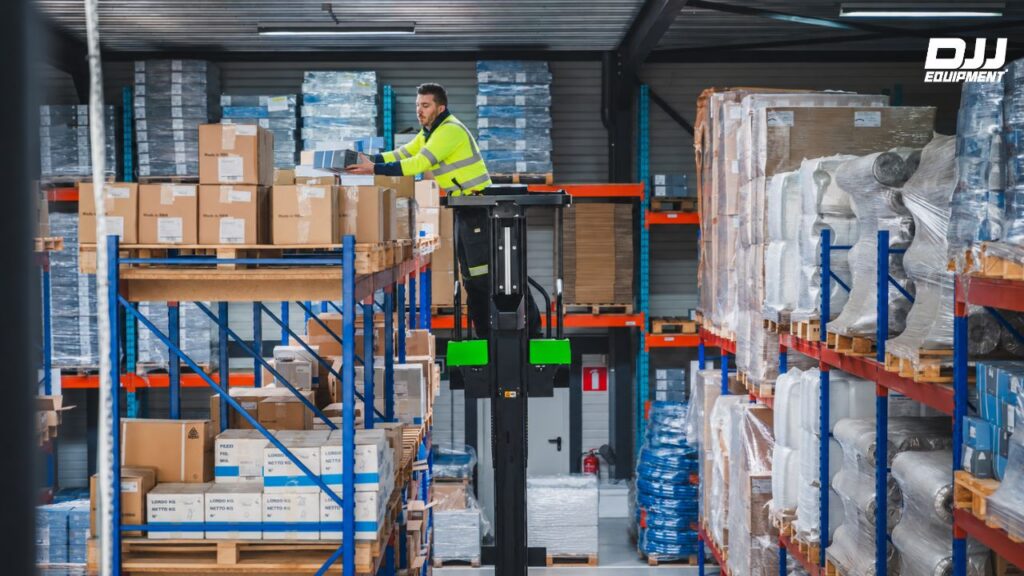
With the platform raised, the operator stays inside it, with the gates closed and the harness clipped, and moves the truck to the stock instead of reaching for it. WorkSafe Victoria sets three limits. No walking onto a pallet carried on the order picker, no leaving the truck to step into the racking, and in narrow aisles, racking that is decked or holds a pallet on each beam.
The decking rule matters because many platforms are only partly enclosed. An empty bay beside an open side leaves nothing between the operator and the floor.
Capacity falls as the forks rise, so the load at height matters too. The A Series high-level order picker 1.2 t carries 1,200 kg up to 3 m of lift, 1,000 kg at 5 m and 400 kg at its top 9.5 m, at a 400 mm load centre. Read the capacity at your top pick height, not the headline figure.
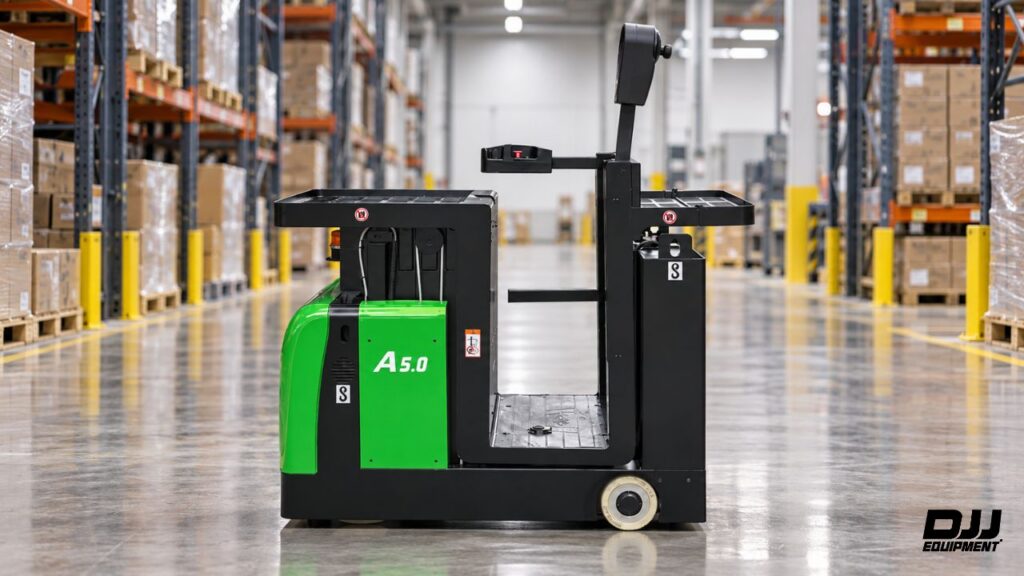
Small stock pickers set a limit for each zone. The A Series stock picker 0.5 t is rated for 250 kg on the front tray, 100 kg on the rear tray and 150 kg on the standing platform, operator included.
Which order picker safety features stop the truck?
A modern order picker stops itself when something is wrong. On the Hangcha A Series order pickers below, the truck won't move until the guardrails are locked in place, and most also need the operator standing on the safety pedal. A tilt switch stops it when it leans too far, and travel slows as the platform climbs.
Speed is limited because a raised platform lifts the centre of gravity of the truck, the load and the operator. A hard stop or a fast corner then pushes that weight sideways, and a force the truck shrugs off at floor level can tip it at 6 m. Safe Work Australia's lift truck guide tells operators of other trucks not to drive with a raised load, one of the basic ways to prevent a forklift from tipping over. An order picker is built to travel with its platform up, so the truck caps its own speed instead.
The table compares the standard safety systems on four Hangcha order pickers that DJJ Equipment sells.
| Model | Top travel speed | With the platform raised | Emergency lowering | Other standard safety systems |
|---|---|---|---|---|
| A Series high-level order picker 1.2 t | 10 km/h laden | Slows as it rises, no travel above 6 m | From the platform and from the rear of the truck | Tilt switch, guardrail switches, mast chain with a 10 times safety factor and a chain switch |
| A Series narrow aisle high-level order picker 1.3 t | 12 km/h up to 500 mm of lift | 1 km/h above 4.9 m | Manual lowering valve at the rear | Safety pedal, tilt switch, guardrail switches, pallet clamp |
| A Series medium-level order picker 1 t | 9 km/h | Slows as it rises | Manual lowering valve at the rear | Safety pedal, tilt detection, side barrier switches |
| A Series stock picker 0.5 t | 5.5 km/h | Slows as it rises | Manual lowering valve at the rear | Safety pedal sensor, tilt sensor, guardrail switches |
The higher the truck can lift, the harder it limits travel. The 1.2 tonne truck stops travelling above 6 m, and the 1.3 tonne truck drops from 12 km/h to 1 km/h above 4.9 m. All four also slow in corners.
The tilt detection on the medium-level truck goes a step further. Once it trips, the truck won't work again until the cab is lowered below a set height, so the operator has to come down before carrying on.
How do you rescue someone stuck on a raised order picker?
Rescue from an order picker starts with lowering the platform, so the operator and at least one person on the floor need to know where the emergency lowering control is. On the 1.2 t high-level truck, emergency lowering works from the platform and from the rear of the truck. The 1.3 t, the 1 t medium-level truck and the 0.5 t stock picker have a manual lowering valve at the rear, so someone on the floor can bring the platform down if the operator can't.
The law also asks for a plan. Under WHS Regulation 80, a business that uses a fall arrest system must set up emergency and rescue procedures, test them and train workers in them. The Code says a worker hanging in a full-body harness should be rescued promptly to prevent suspension intolerance, and that a worker shouldn't use fall arrest unless another person on site can rescue them.
A restraint that keeps the operator on the platform shouldn't leave anyone hanging. WorkSafe Victoria's warning about long lines shows how easily it can, so plan the rescue anyway. Practise it on the truck itself, so the person on the floor finds the valve once before they need it.
Can two people ride on an order picker?
No, not unless the maker designed the order picker to carry a second person. Safe Work Australia's general guide for industrial lift trucks says a truck must not carry a passenger unless it's designed for a seated passenger, with a passenger seat fitted with suitable seat restraints.
The Hangcha order pickers in the table carry the operator on a single platform, and the stock picker's platform rating already counts the operator.
Never lift a second person on the forks or a pallet to reach a higher shelf. It's the same fall WorkSafe Victoria warns about when it rules out walking onto pallets attached to the truck.
What should an order picker pre-start check cover?
An order picker pre-start check covers everything a standard electric truck check does, plus every system that holds the operator in place at height. Check these before the first lift of the shift:
- Guardrails and gates. They latch, and the truck refuses to drive with them open.
- Safety pedal, where fitted. The truck won't move unless it's pressed.
- Harness, lanyard and anchor point. No cuts or fraying, and the line set to the right length for the platform.
- Emergency lowering. The operator and a person on the floor both know where the control or valve is.
- Lift and lower. The platform moves smoothly and holds position when the control is released.
- Floor and aisle. Clean, level and clear of pedestrians. The A Series stock picker 0.5 t is rated for a 5% gradient, so it belongs on flat warehouse floors, not ramps.
Tag out any truck that fails the check. A guardrail switch that has been bypassed removes the first control the WHS hierarchy relies on.
Do order picker operators need a licence?
Yes, an order picker operator needs a High Risk Work Licence class LO, because the operator's controls rise with the load. Safe Work Australia's lift truck guide uses that test to define what an order picker forklift is in law, and class LF, which covers reach trucks and counterbalance forklifts, doesn't replace LO.
The licence isn't enough on its own. WorkSafe Victoria says each operator must be able to show safe use of the order picker, harness, lanyard and inertia reel, and that training records should be kept.
DJJ supplies Hangcha order pickers from the 0.5 t stock picker to high-level trucks that lift the forks to 9.5 m, for sale and on hire on selected models. Tell us your top pick height and your narrowest aisle, and we'll match the order picker to your racking. Call 1800 355 388 or send an enquiry to the Silverwater, Meadowbrook or Bayswater branch.